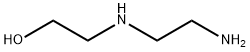
The general procedure for the synthesis of 2-[(2-aminoethyl)amino]ethanesulfonic acid sodium salt (50% aqueous solution) from hydroxyethyl ethylenediamine was as follows: 5.0 g of β-hydroxyethyl ethylenediamine (1 mol) was placed in a three-necked flask assembled with a stirrer, a thermometer, a dropping funnel, and an ice-salt bath. Concentrated sulfuric acid was slowly added through the dropping funnel while the reaction temperature was maintained below 10 °C using an ice-salt bath during the dropping process until the sulfuric acid addition was complete. After removing the ice-salt bath, the reaction mixture is heated for vacuum distillation until no anhydrous fraction is distilled out to give the intermediate product ethylenediamine ethanol sulfate. Toluene may be added as a water-carrying agent during this process. After the reaction product is cooled to room temperature, sodium carbonate solution is added dropwise until no more gas is produced. Subsequently, a preheated prepared saturated sodium sulfite solution (151 g solute) is added for the sulfonation reaction. The reaction was refluxed at 100 to 120°C for 30 h. Upon completion of the reaction, partial vacuum distillation was carried out, cooled to 9095°C, and filtered while hot to remove the sodium sulfate and sodium sulfite crystals to obtain the crude sodium salt of ethylenediamine sulfonate. A higher purity sodium salt of ethylenediamine sulfonate can be obtained by subsequent refining processes such as cooling and crystallization, acidification, recrystallization and purification and salting out, with a combined product yield of 75%. It should be noted that the use of concentrated sulfuric acid in this process has high requirements for equipment and produces pollutant gases such as sulfur dioxide; at the same time, due to the need to recrystallize several times to separate the sodium sulfate, a large amount of acid-containing wastewater will be generated.

![sodium 2-[(2-aminoethyl)amino]ethanesulphonate Structure](/CAS/GIF/34730-59-1.gif)
![sodium 2-[(2-aminoethyl)amino]ethanesulphonate pictures](/ProductImageEN1/2025-02/Small/064fcef4-6f91-456e-a0f6-f1fdfcbfd582.jpg)
![sodium 2-[(2-aminoethyl)amino]ethanesulphonate pictures](/ProductImageEN/2023-11/Small/50fc9382-189a-461e-9522-7a6c14d3613e.jpg)
![sodium 2-[(2-aminoethyl)amino]ethanesulphonate pictures](/ProductImageEN/2022-09/Small/0ab1a765-bd3f-455e-8c3c-090abd947ad6.jpg)