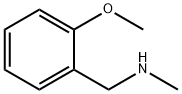
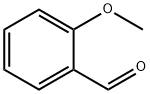
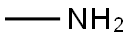
Step A: 2-methoxybenzaldehyde (5.56 g, 40 mmol) was dissolved in methanol (40 mL) and methylamine (40 wt% aqueous solution, 6.9 mL, 80 mmol) and acetic acid (240 mg, 4 mmol) were added sequentially. The reaction mixture was stirred at room temperature for 16 h and then cooled in an ice bath. Sodium borohydride (1.51 g, 40 mmol) was added in batches under ice bath cooling conditions. After addition, the reaction mixture was continued to stir at room temperature for 3 hours. After completion of the reaction, most of the solvent was removed by concentration under reduced pressure. The residue was diluted with distilled water (100 mL) and ethyl acetate (100 mL) and partitioned. The aqueous phase was extracted with ethyl acetate (2 × 100 mL) and the organic phases were combined. The organic phase was washed sequentially with saturated brine, dried over anhydrous sodium sulfate, and concentrated under reduced pressure to afford the target product N-methyl-2-methoxybenzylamine (4.7 g, 79% yield). The product was characterized by 1H NMR (CDCl3, 500 MHz): δ 7.23 (d, J = 7.4 Hz, 2H), 6.91 (t, J = 7.4 Hz, 1H), 6.86 (d, J = 7.9 Hz, 1H), 3.83 (s, 3H), 3.75 (s, 2H), 2.42 (s, 3H); ESI MS m/z = 152 [M + H]+. The crude product obtained can be used directly in the subsequent reaction without further purification.