It is used as therapy to treat recurrent herpes simplex infections.
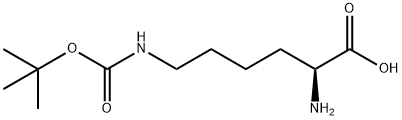
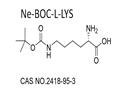
H-Lys(Boc)-OH, also known as H-Lys(t-BOC)-OH, is an ε-amino-protected lysine. Its e-amino free lysine could be conjugated to polyurethane surfaces by reaction of the alpha-amino group with the NHS and deprotection. The covalent conjugation was carried out in phosphate-buffered saline (PBS), pH 8.2. Lysine was used to create a plasminogen-binding potentially fibrinolytic surface[1].
[1] Chen H , et al. Surfaces having dual fibrinolytic and protein resistant properties by immobilization of lysine on polyurethane through a PEG spacer. Journal of Biomedical Materials Research Part A, 2008; 90A: 940-946.
reaction type: solution phase peptide synthesis
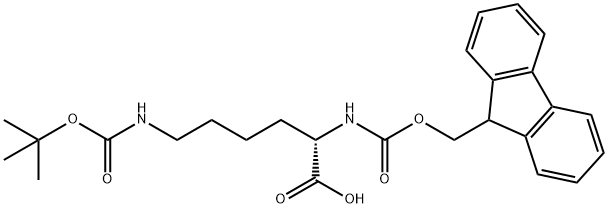
Step 1. N-alpha-Fluorenylmethoxycarbonyl-N-epsilon-tert-butoxycarbonyl-L-lysine (5 g, 10.7 mmol) was dissolved in dichloromethane (DCM) at room temperature and piperidine (5.5 ml, 53 mmol) was added with stirring. The reaction mixture was stirred continuously for 16 hours at room temperature. Upon completion of the reaction, the reaction mixture was extracted with water, the aqueous phase was combined and concentrated to afford N(e)-Boc-L-lysine (20-3) in 95% yield.