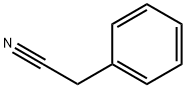
Benzyl cyanide is a colorless, oily liquid withan aromatic odor. Molecular weight=117.2; Boilingpoint=233.5℃; Freezing/Melting point=2 24; Vaporpressure=low , 0.40 at 20℃; Flash point=113℃(oc), also cited as 101℃. Hazard Identification (basedon NFPA-704 M Rating System): Health 3, Flammability 1,Reactivity 0. Insoluble in water.
Benzyl cyanide is a colorless, oily liquid with
an aromatic odor.
Phenylacetonitrile is used in organic synthesis for dyes, perfumes, pharmaceuticals, especially penicillin precursors. It is also used as a solvent.
Organic synthesis, especially penicillin precursors.
Benzyl cyanide is synthesized by reaction of benzyl chloride with potassium
cyanide or sodium cyanide . The nitrile is a natural constituent of
plants and is a constituent of foods, particularly citrus fruits, papaya, cabbage,
mushrooms, roasted onions, tomatoes, cocoa, tea, roasted peanuts and cauliflower
.The benzyl cyanide, at least in part, is formed by breakdown of
benzylglucosinolate in the plant material. Benzyl
nitrile also is found in tap water, river water, sewage and in
cigarette smoke ).
ChEBI: A nitrile that is acetonitrile where one of the methyl hydrogens is substituted by a phenyl group.
Canadian Journal of Chemistry, 39, p. 1340, 1961
DOI: 10.1139/v61-169Chemistry Letters, 13, p. 1511, 1984
Organic Syntheses, Coll. Vol. 1, p. 107, 1941
A colorless oily liquid with an aromatic odor. Insoluble in water and slightly denser than water. Contact may irritate skin, eyes, and mucous membranes. May be toxic by ingestion. Used to make other chemicals.
Benzeneacetonitrile is moisture sensitive. Insoluble in water.
PHENYLACETONITRILE can react with strong acids, strong bases, strong oxidizing agents and strong reducing agents. Benzeneacetonitrile may react vigorously with sodium hypochlorite. .
Highly toxic, absorbed by skin.
Poisonous. May be fatal if inhaled, swallowed, or absorbed through skin. Contact may cause burns to skin and eyes.
Benzyl cyanide is a highly toxic irritant that may be fatal if inhaled, swallowed or
absorbed through the skin. The chemical causes eye, mucous
membrane and skin irritation. Benzyl cyanide was applied as a 2% concentration
in petroleum to the skin of 27 human volunteers and found to be nonsensitizing.
When heated to decomposition, Benzeneacetonitrile emits very toxic fumes of cyanide and nitrogen oxides. Container may explode in heat of fire. Runoff from fire control water may give off poisonous gases. Avoid sodium hypochlorite.
Benzyl cyanide is employed as a chemical intermediate for the synthesis of
amphetamine, phenobarbital and methyl phenidylacetate. It is also used for
perfumes and flavors and is, therefore, added to soaps, detergents, creams and
lotions.
Poison by ingestion, inhalation, skin contact, subcutaneous, and intraperitoneal routes. A skin irritant. Explosive reaction with sodium hypochlorite. Used in production of drugs of abuse. When heated to decomposition it emits very toxic fumes of CNand NOx. See also NITRILES
(as CN): Benzyl cyanide is used in
organic synthesis, especially of penicillin precursors. It is
used as a chemical intermediate for amphetamines, phenobarbital;
the stimulant, methyl phenidylacetate; esters as
perfumes and flavors.
If this chemical gets into the eyes, remove anycontact lenses at once and irrigate immediately for at least15 min, occasionally lifting upper and lower lids. Seek medical attention immediately. If this chemical contacts theskin, remove contaminated clothing and wash immediatelywith soap and water. Speed in removing material from skinis of extreme importance. Seek medical attention immediately. If this chemical has been inhaled, remove from exposure, begin rescue breathing (using universal precautions,including resuscitation mask) if breathing has stopped andCPR if heart action has stopped. Transfer promptly to amedical facility. When this chemical has been swallowed,get medical attention. Give large quantities of water andinduce vomiting. Do not make an unconscious personvomit. For cyanide poisoning, use amyl nitrate capsules ifsymptoms develop. All area employees should be trainedregularly in emergency measures for cyanide poisoning andin CPR. A cyanide antidote kit should be kept in the immediate work area and must be rapidly available. Kit ingredients should be replaced every 1� 2 years to ensurefreshness. Persons trained in the use of this kit, oxygen use,and CPR must be quickly available.
Giacosa isolated phenylaceturic acid from the urine of a dog dosed with
benzyl cyanide, while Adeline et al showed that in the dog, benzyl cyanide
formed both benzoic acid and a small amount of ethereal sulfate. In rabbits, a large
proportion of the cyano group could be accounted for as thiocyanate ion in the
urine. There was a sex difference in the conversion with
female rabbits excreting 70% of the dose as thiocyanate and males only 50%.
However, cyanide was liberated slowly from i.p. or orally administered benzyl
cyanide in rats and excreted in the urine as cyanide and thiocyanate, the proportion
of the former increasing with the dose .
Benzyl cyanide is oxidized by mouse liver microsomes to benzaldehyde and
cyanide ion presumably via the intermediate mandelonitrile.
The microsomal metabolism of benzyl cyanide and other nitriles was significantly
increased when mice were pre treated with ethanol ,
suggesting that the ethanol-inducible cytochrome P-450 may
play an important role in the metabolism of such compounds.
Color Code—Blue: Health Hazard: Store in asecure poison location. Store in tightly closed containers ina cool, well-ventilated area away from oxidizers and otherincompatible materials listed above. Sources of ignition,such as smoking and open flames, are prohibited where thischemical is used, handled, or stored in a manner that couldcreate a potential fire or explosion hazard.
UN2470 Phenylacetonitrile, Hazard Class: 6.1;
Labels: 6.1—Poisonous materials.
Any benzyl isocyanide impurity can be removed by shaking vigorously with an equal volume of 50% H2SO4 at 60o, washing with saturated aqueous NaHCO3, then half-saturated NaCl solution, drying and fractionally distilling under reduced pressure. Distillation from CaH2 causes some decomposition of this compound: it is better to use P2O5. Other purification procedures include passage through a column of highly activated alumina, and distillation from Raney nickel. Precautions should be taken because of possible formation of free TOXIC cyanide, use an efficient fume cupboard.[Beilstein 9 IV 1663.]
Violent reaction with strong oxidizers;
sodium hypochlorite, lithium aluminum hydride. Nitriles
may polymerize in the presence of metals and some metal
compounds. They are incompatible with acids; mixing
nitriles with strong oxidizing acids can lead to extremely
violent reactions. Nitriles are generally incompatible with
other oxidizing agents such as peroxides and epoxides.
The combination of bases and nitriles can produce hydrogen
cyanide. Nitriles are hydrolyzed in both aqueous acid
and base to give carboxylic acids (or salts of carboxylic
acids). These reactions generate heat. Peroxides convert
nitriles to amides. Nitriles can react vigorously with
reducing agents. Acetonitrile and propionitrile are soluble
in water, but nitriles higher than propionitrile have low
aqueous solubility. They are also insoluble in aqueous
acids.