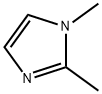
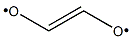
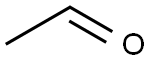
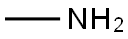
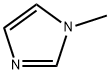
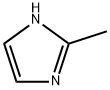
A high-pressure microreactor equipped with three micro-mixers was used for the synthesis. It was operated as follows: an aqueous methylamine solution (0.33 mol/L) was fed from tank 1 via pump 1 at a flow rate of 0.68 mL/min; an aqueous acetaldehyde solution (0.33 mol/L) was fed from tank 3 via pump 3A at a flow rate of 63 mL/min while nearby water (0.33 mol/L) flowed at a flow rate of 1.13 mL/min; an aqueous glyoxal solution ( 0.33 mol/L) was fed from tank 4 via pump 4 at a flow rate of 0.56 mL/min. The reaction pressure was set to 30 MPa and the final flow rate was 8.0 mL/min. The temperature of the first micro-mixer and the 2.4 m reaction tube was controlled at 25 °C by the thermostat chamber 1 , under which the mixing and reaction of methylamine with acetaldehyde was carried out. Subsequently, in the second micro-mixer, the reaction mixture was mixed with ammonia and kept at 25 °C in the constant temperature chamber 2, and the reaction was fully mixed and reacted in the 0.1 m reaction tube. Next, glyoxal was added to the reaction system and fully reacted in a 0 m reaction tube. Subsequently, the temperature of the reaction zone was raised to 70 °C and the reaction was continued in a 25 μm reaction tube. Finally, the reaction mixture was cooled to 5 °C by a heat exchanger, depressurized to atmospheric pressure by a pressure reducing valve, and the aqueous solution obtained under cooling in ice water (0 °C to 4 °C) was collected. The residence time of the reaction part was 37 seconds throughout the reaction. For analysis, the product was diluted 10-fold with ice water, if necessary, and analyzed immediately using a gas chromatograph. The reaction tube was made of stainless steel (SUS316) with an inner diameter of 0.5 mm. the yield of the product 1,2-dimethylimidazole was 85.1%. The quantitative analysis was performed on an Agilent gas chromatograph (GC 6890, hydrogen flame ionization detector) with an HP-INNOWAX column (inner diameter 0.32 mm, film thickness 0.25 μm, length 30 m) manufactured by J & W Co. The yield of each product (1,2-dimethylimidazole, 1-methylimidazole, 2-methylimidazole, and imidazole) was determined by preparing standard curves for each product. The yield of each product was calculated based on the concentration obtained by conversion of the standard curve as follows: 1,2-dimethylimidazole 85.1%, 1-methylimidazole 6.27%, 2-methylimidazole 6.59%, and imidazole 2.06%.