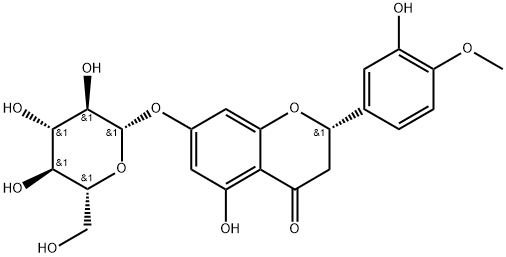
Hesperetin 7-O-glucoside, also known as Eriodictiol-7-glucoside, is a flavonoid compound. The hesperetin 7-O-glucoside has a monosaccharide glucoside at position C7 and is the hydrolysis product of hesperidin by colonic microflora and can be readily absorbed in the small intestine (i.e., in the digestive tract) along with deglycosylated aglycone hesperetin (4′-methoxy-3′,5,7-trihydroxyflavanone), a member of the flavanone subclass of flavonoids. Hesperidin, hesperetin 7-O-glucoside, and aglycone hesperetin have been reported to have antioxidant, anti-inflammatory, antimicrobial, anti-carcinogenic, cardio-protective, antidepressant, and anti-hypercholesterolemia effects. In addition, these compounds have the capacity to reduce the risk of osteoporosis, kidney diseases, cytotoxicity, infertility, diabetes, and hypertension[1].
Hesperetin 7-O-glucoside can be used to treat osteoporosis, scavenging free radicals, varicose veins, reducing blood lipid and decreasing blood pressure. It can also be used to promote plant growth and treat plant anti-bacterial infections.
It has been described that Hesperetin 7-O-glucoside inhibits in vitro human intestinal maltase and HMG-CoA reductase–the key enzyme for cholesterol synthesis–, and inhibits the growth of Helicobacter pylori, a causative agent for gastric diseases such as gastritis, duodenal ulcer, and gastric cancer[2].
[1] Kapoor, M. P., Moriwaki, M., Minoura, K., Timm, D., Abe, A., Kito, K. (2022). Structural Investigation of Hesperetin-7-
O-Glucoside Inclusion Complex with β-Cyclodextrin: A Spectroscopic Assessment.
Molecules.
https://doi.org/10.3390/molecules27175395[2] Céliz, G., Rodriguez, J., Soria, F., Daz, M. (2015). Synthesis of hesperetin 7-O-glucoside from flavonoids extracted from Citrus waste using both free and immobilized α-l-rhamnosidases.
Biocatalysis and Agricultural Biotechnology,
4 3, Pages 335-341.
https://doi.org/10.1016/j.bcab.2015.06.005