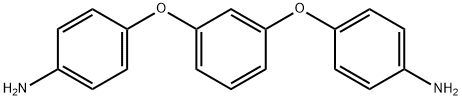
1,3-Bis(4'-aminophenoxyl)benzene be used for the preparation of a polyimide material.
1,3-Bis(4-aMinophenoxy)benzene (TPE-R) is a phenyl ether derivative with two anilines in the terminal closure. It has the following applications:
(1) TPE-R with BPDA and BPDA can be used to prepare a series of polyimide oligomer (Oligo-PI) resins with controlled molecular weights through polymerisation reactions. Oligo-PI resins have an asymmetric and amorphous structure, which allows for better processing of composite materials.
(2) TPE-R copolymerised with other monomers (e.g. PEG) for the manufacture of fuel cell membranes with high ionic conductivity (210 mS/cm) and sufficient thermal stability (up to 140 °C).
(3) Polyimide composites prepared from TPE-R and titanate nanotubes can be used for electromagnetic shielding at microwave frequencies.
(4) TPE-R as an aromatic ligand can be crystallised with a variety of transition metals to form 0D, 1D and 2D coordination metal polymers, which can be used for sensing nitroaromatic compounds.
(5) TPE-R reacts with polydimethylsiloxanes with varying degrees of chloromethyl side functionalisation to form sec-amides and undergo cross-linking to form two networks, a siloxane-organic network and a silica network.
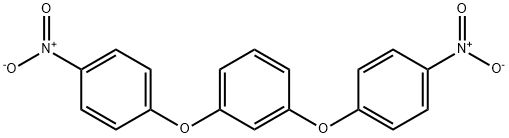
GENERAL METHOD: A mixture of 1,3-bis(4-nitrophenoxy)benzene (1.8 g, 5.1 mmol) with 10% Pd/C (0.2 g) in methanol (70 mL) was subjected to a hydrogen atmosphere and stirred at room temperature overnight. Upon completion of the reaction, the reaction mixture was treated by diafiltration, followed by addition of water (50 mL) to the filtrate and extraction with dichloromethane three times (3 x 50 mL). The organic layers were combined, washed with brine, dried over anhydrous sodium sulfate and concentrated under reduced pressure. The crude product was purified by column chromatography to afford the target product 1,3-bis(4'-aminophenoxy)benzene as a brown solid in 56.0%, 55.0% and 69.0% yields.
orl-mus LD50:1240 mg/kg; orl-rat LD50:1378 mg/kg; ora-rat LD50:690 mg/kg [pubchem].
[1] Heteroatom Chemistry, 2013, vol. 24, # 1, p. 9 - 17
[2] Dyes and Pigments, 2015, vol. 121, p. 170 - 177
[3] Chinese Chemical Letters, 2013, vol. 24, # 10, p. 869 - 872