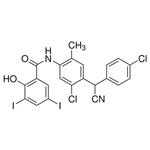
Closantel
- Product NameClosantel
- CAS57808-65-8
- MFC22H14Cl2I2N2O2
- MW663.07
- EINECS260-967-1
- MOL File57808-65-8.mol
Chemical Properties
| Melting point | 217.8° |
| Boiling point | 590.5±50.0 °C(Predicted) |
| Density | 1.8759 (estimate) |
| storage temp. | Keep in dark place,Sealed in dry,2-8°C |
| solubility | DMF: 20 mg/ml; DMSO: 20 mg/ml; DMSO:PBS (pH 7.2)(1:5): 0.16 mg/ml |
| form | Solid |
| pka | 5.99±0.48(Predicted) |
| color | White to off-white |
| Major Application | agriculture environmental |
| InChI | 1S/C22H14Cl2I2N2O2/c1-11-6-15(17(10-27)12-2-4-13(23)5-3-12)18(24)9-20(11)28-22(30)16-7-14(25)8-19(26)21(16)29/h2-9,17,29H,1H3,(H,28,30) |
| InChIKey | JMPFSEBWVLAJKM-UHFFFAOYSA-N |
| SMILES | Cc1cc(C(C#N)c2ccc(Cl)cc2)c(Cl)cc1NC(=O)c3cc(I)cc(I)c3O |
| CAS DataBase Reference | 57808-65-8(CAS DataBase Reference) |
Safety Information
| Hazard Codes | Xn |
| Risk Statements | 22 |
| RIDADR | 2811 |
| WGK Germany | 3 |
| RTECS | CV2444250 |
| HazardClass | 6.1(b) |
| PackingGroup | III |
| Storage Class | 6.1C - Combustible acute toxic Cat.3 toxic compounds or compounds which causing chronic effects |
| Hazard Classifications | Acute Tox. 3 Oral Aquatic Chronic 4 |
| Toxicity | A veterinary drug for the treatment of fluke and nematode infestations. In 1993, some was included in a batch of donated drugs sent to Lithuania. Attempts to match the product with the names of other medicines on accompanying literature resulted in its misidentification as a treatment for endometriosis. Eleven women lost their eyesight; though this has since returned, they were left with eye pain and are unable to work. |