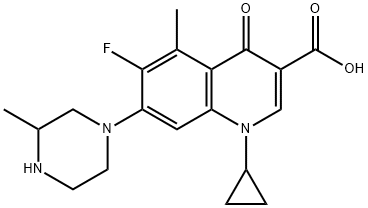
1-Bromo-2,4,5-trifluoro-3-(trimethylsilyl)benzene (i) and methyl trifluoromethanesulfonate (ii) dissolved in THF react under butyllithium and diisopropylethylamine conditions to give 2-bromo-3,5,6-trifluoro-4-(trimethylsilane)toluene (iii). Passing through butyllithium and carbon dioxide yields 2,4,5-trifluoro-6-methyl-3-(trimethylsilyl)benzoic acid (iv), which reacts in acetonitrile and CSF to give the corresponding benzoic acid (v). This benzoic acid then reacts with monoethyl malonate and... The reaction of oxaloyl chloride and butyllithium yields ethyl 3-(3,4,6-trifluoro-2-methylphenyl)-2-oxopropionate (Vii), which is then condensed with triethyl acetic anhydride orthoformate to form an ethoxylated derivative (VIII). This derivative then undergoes a cyclization reaction with cyclopropylamine to give ethyl 1-cyclopropyl-6,7-difluoro-5-methyl-4-oxo-1,4-dihydroquinoline-3-carboxylic acid (x), which is hydrolyzed to give the corresponding free acid (Xi). Finally, this compound is condensed with 2-methylpiperazine (Xii) to give the final product, Grepafloxacin.
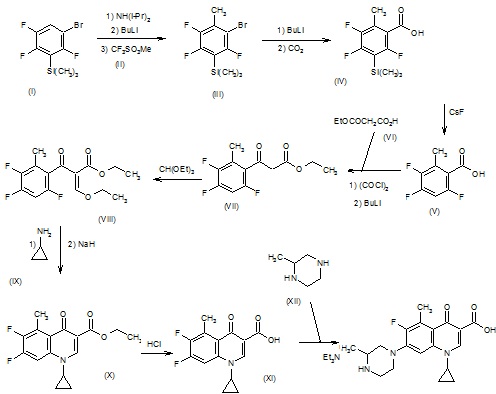
Figure 1 shows the synthetic route of Grepafloxacin.