White to yellow to light brown powder
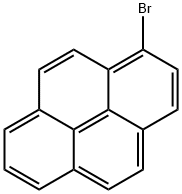
1-Bromopyrene is suitable reagent used in the comparative study of effect of substituents of some pyrene derivatives in inducing phototoxicity, DNA damage and repair in human skin keratinocytes and light-induced lipid peroxidation in methanol. It is suitable reagent used in the study to investigate the UV photon-assisted thermal decomposition of PAHs at elevated temperature.
1-Bromopyrene may be used as a standard to compare its spectral properties with that of pyrene based fluorescence probe. It may be used to study the effects of the addition of halogen hetero-atoms on the vapor pressures and thermodynamics of polycyclic aromatic hydrocarbons.
It may be used in the synthesis of the following:
2-methyl-4-pyren-1-yl-but-3-yn-2-ol
1-ethynylpyrene
silsesquioxane (SSQ) based hybrid
ruthenium nanoparticles functionalized with pyrene moiety
mono- and di-pyrenyl perfluoroalkanes
oligo(1-bromopyrene)(OBrP) films
dinitropyrene-derived DNA adduct
1-Bromopyrene is used in the cleavage of DNA in studies. It is also used in the preparation of DNA base analogs.
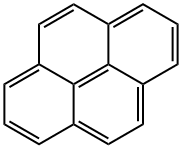
1-Bromopyrene is an important intermediate in the OLED material industry. The synthesis method is as follows: pyrene is dissolved in an organic solvent dichloromethane, and dibromohydantoin is added for reaction, filtered, and the obtained solid is recrystallized to obtain 1-bromopyrene.
1-Bromopyrene, a polycyclic aromatic hydrocarbon (PAH), is a mono bromo substituted pyrene derivative. Its synthesis has been reported. Its gas phase UV-absorption spectra in the UV wavelength range at elevated temperature has been studied. Electron affinitiy (EA) of 1-bromopyrene has been investigated using electron attachment desorption chemical ionization mass spectrometry (DCI-MS) and triple quadrupole tandem mass spectrometry. It participates in the synthesis of novel ruthenium (II) bipyridine or terpyridine complexes bearing pyrene moiety. The reaction of 1-bromopyrene cation radical with water in acetonitrile has been analyzed using the electron transfer stopped-flow (ETSF) method.
The general procedure for the synthesis of 1-bromopyrene from pyrene was as follows: anhydrous N,N-dimethylformamide (DMF, 5 mL) solution of N-bromosuccinimide (NBS, 187 mg, 1.05 mmol) was slowly added dropwise to anhydrous DMF (10 mL) solution of pyrene (252 mg, 1.0 mmol) and the reaction mixture was stirred at room temperature for 24 hours. After completion of the reaction, the mixture was poured into deionized water (50 mL) and extracted three times with dichloromethane (100 mL). The organic phases were combined, washed thoroughly with deionized water, dried over anhydrous magnesium sulfate (MgSO4), and concentrated under reduced pressure to remove the solvent to give the crude product 1-bromopyrene (332 mg, 85% yield) as a light yellow solid. The crude product was recrystallized with hexane to obtain pure 1-bromopyrene as light yellow powder, melting point 103-104°C (literature value: 102-104°C).
[1] Tetrahedron Letters, 2010, vol. 51, # 9, p. 1317 - 1321
[2] Journal of the Chinese Chemical Society, 2012, vol. 59, # 3, p. 289 - 296
[3] Tetrahedron Letters, 2003, vol. 44, # 21, p. 4085 - 4088
[4] European Journal of Organic Chemistry, 2011, # 27, p. 5261 - 5271
[5] Zeitschrift fur Naturforschung - Section B Journal of Chemical Sciences, 2013, vol. 68, # 4, p. 367 - 377