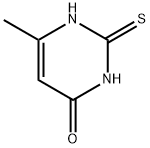
6-Methyl-2-thiouracil is a derivative of methylthiouracil (M330710), a competitive inhibitor of Nitric Oxide Synthase (NOS). Potential anti-inflammatory agent.
ChEBI: Methylthiouracil is a pyrimidone.
White crystalline powder with an odor of onions and a bitter taste. A saturated aqueous solution is neutral or slightly acidic.
Methylthiouracil reacts with strong oxidizing agents. Forms complexes with metals and is oxidized by iodine and other sulfhydryl oxidizing agents .
Flash point data for Methylthiouracil are not available. Methylthiouracil is probably combustible.
Confirmed carcinogen
with experimental carcinogenic,
neoplastigenic, tumorigenic, and teratogenic
data. Poison by intraperitoneal route.
Moderately toxic by ingestion. Human
teratogenic and reproductive effects by an
unspecified route: developmental
abnormalities of the endocrine system and
effects on newborn including neonatal
measures or effects. Experimental
reproductive effects. Used to treat
hyperthyroidism. When heated to
decomposition it emits very toxic fumes of
NOx and SOx.
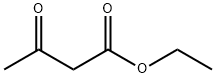
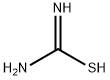
Sodium metal (30 mmol) was added to methanol (10 mL) and after complete dissolution, thiourea (10 mmol) and ethyl acetoacetate (10 mmol) were added sequentially. The reaction mixture was heated to reflux for 7 hours. After completion of the reaction, methanol was removed by distillation under reduced pressure and the residue was dissolved in an appropriate amount of water and the pH was adjusted to neutral with acetic acid. The precipitate was collected by filtration to give the pale yellow crystalline product methylthiouracil (1.26 g, 90% yield). The product was characterized as follows: melting point 275-277°C; 1H NMR (δ, ppm): 2.09 (s, 3H, 6-CH3), 5.52 (s, 1H, CH-pyrimidine), 11.98 [b.s, 2H, (NH)2]; 13C NMR (δ, ppm): 17.88, 103.38, 151.91, 160.32, 175.83. 175.83. Elemental analysis results (C5H6N2OS) calculated values: C, 42.24; H, 4.25; N, 19.70; S, 22.55; measured values: C, 42.24; H, 4.25; N, 19.70; S, 22.55.
Crystallise the thiouracil from a large volume of H2O. Purify it further by dissolving in base, adding charcoal, filtering and acidifying with AcOH. Suspend the wet solid (ca 100g) in boiling H2O (1L), stir and add AcOH (20mL), stir and refrigerate. Collect the product, wash it with cold H2O (4 x 200mL), drain it for several hours then place it in an oven at 70o to constant weight. [IR: Short & Thompson J Chem Soc 168 1952, Foster & Snyder Org Synth Coll Vol IV 638 1063, Beilstein 24 III/IV 1289.]
[1] Organic Process Research and Development, 2010, vol. 14, # 1, p. 205 - 214
[2] Journal of Chemistry, 2017, vol. 2017,
[3] RSC Advances, 2017, vol. 7, # 28, p. 17427 - 17441
[4] Synthetic Communications, 2002, vol. 32, # 6, p. 851 - 855
[5] Journal of the Chemical Society of Pakistan, 2011, vol. 33, # 6, p. 893 - 899