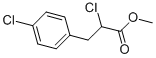
The commercial production of chlorfenprop-methyl begins with the preparation of 4-chlorocinnamic acid via a Perkin condensation, where 4-chlorobenzaldehyde is reacted with malonic anhydride in the presence of a base catalyst like pyridine or triethylamine, followed by hydrolysis and decarboxylation to yield the alpha,beta-unsaturated carboxylic acid. This intermediate is then hydrogenated using catalytic hydrogenation with palladium on carbon or Raney nickel in a solvent producing the saturated 3-(4-chlorophenyl)propionic acid. The key alpha-chlorination step involves treating the propionic acid with chlorine gas or N-chlorosuccinimide in an inert solvent under UV irradiation or free-radical initiation, introducing the chlorine at the alpha-position, yielding 2-chloro-3-(4-chlorophenyl)propionic acid. Finally, esterification is performed by reacting the chlorinated acid with methanol in the presence of a strong acid catalyst such as sulphuric acid, or via a Fischer-Speier method under reflux with Dean-Stark azeotropic removal of water, followed by neutralisation, extraction, and distillation to isolate technical-grade chlorfenprop-methyl.