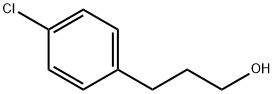
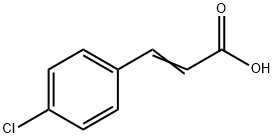
General procedure for the synthesis of 3-(4-chlorophenyl)propan-1-ol from p-chlorocinnamic acid: yield range 23.3-88.0%. As an example, 3-(4-chlorophenyl)propan-1-ol (3c) was synthesized as follows: under nitrogen protection and an ice bath, a THF solution of 3-(4-chlorophenyl)acrylic acid (2c, 2.74 g, 15 mmol) was slowly added to a tetrahydrofuran (THF, 30 mL) suspension of lithium aluminium hydride (1.71 g, 45 mmol), and the addition process was controlled to be completed within 30 min. The addition process was controlled to be completed within 30 min. The reaction mixture was stirred to room temperature and then continued to reflux for 4 hours. The progress of the reaction was monitored by thin layer chromatography (TLC) and after confirming the complete consumption of the raw materials, the reaction mixture was cooled to room temperature. Subsequently, methanol (15 mL) and water (15 mL) were added slowly and dropwise to quench the reaction and the pH was adjusted with 10% hydrochloric acid solution to 3. The crude product was extracted with ethyl acetate (3 x 30 mL), the organic layers were combined, dried with anhydrous magnesium sulfate (MgSO4) and concentrated under reduced pressure. The resulting yellow oil was purified by silica gel column chromatography (eluent: n-hexane/ethyl acetate=4:1, v/v) to give a yellow oily target product in 54.7% yield. The structure of the product was confirmed by 1H NMR (300 MHz, CDCl3): δ 7.27-7.22 (m, 2H), 7.15-7.10 (m, 2H), 3.66 (t, J=6.4 Hz, 2H), 2.68 (t, J=7.44 Hz, 2H), 1.91-1.81 (m, 2H).