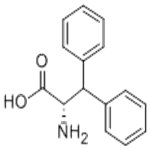
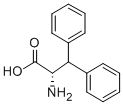
Step 2: 1,1-dimethylethyl-(2R)-(2,6-dichlorophenyl)-(4S)-(diphenylmethyl)-5-oxo-3-((1'R)-phenylethyl)tetrahydro-1H-1-imidazolecarboxylate (188 mg, 0.31 mmol) was dissolved in a solvent mixture of 7.5 mL of tetrahydrofuran and 1 mL of 1 M hydrochloric acid, and the atmosphere of the reaction vessel was replaced with nitrogen. . To the mixture was added 90 mg of 20% palladium-carbon hydroxide catalyst; the atmosphere was again replaced with nitrogen and then hydrogen. After 100 hours of reaction at room temperature and 2.2 MPa hydrogen pressure, the catalyst was separated by filtration. The resulting product was washed once with 5 mL of tetrahydrofuran and 3 mL of distilled water, respectively, and the solvent was removed under reduced pressure. To the mixture was added 7.5 mL of 6M hydrochloric acid; the mixture was heated and refluxed at an external temperature of 120-130°C for 2.5 hours. Thereafter, the reaction mixture was cooled to an external temperature of 0°C. After adjusting the pH to 6 to 7 by adding 30% aqueous sodium hydroxide solution thereto, the solvent was removed under reduced pressure. The amount of (S)-2-amino-3,3-diphenylpropionic acid contained in the residue was determined under the following analytical conditions. As a result, the yield was 76% and the ee value was 95.7%.

![1-Imidazolidinecarboxylic acid, 2-(2,6-dichlorophenyl)-4-(diphenylmethyl)-5-oxo-3-[(1R)-1-phenylethyl]-, 1,1-dimethylethyl ester, (2R,4S)-](/CAS/20210305/GIF/1004755-24-1.gif)