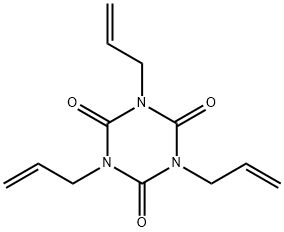
Isocyanates and thioisocyanates, such as 1,3,5-Tri-2-propenyl-1,3,5-triazine-2,4,6(1H,3H,5H)-trione, are incompatible with many classes of compounds, reacting exothermically to release toxic gases. Reactions with amines, aldehydes, alcohols, alkali metals, ketones, mercaptans, strong oxidizers, hydrides, phenols, and peroxides can cause vigorous releases of heat. Acids and bases initiate polymerization reactions in these materials. Some isocyanates react with water to form amines and liberate carbon dioxide. Base-catalysed reactions of isocyanates with alcohols should be carried out in inert solvents. Such reactions in the absence of solvents often occur with explosive violence, [Wischmeyer(1969)].
1,3,5-Tri-2-propenyl-1,3,5-triazine-2,4,6(1H,3H,5H)-trione is probably combustible.
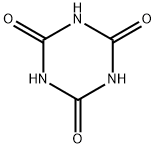
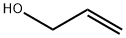
6.45 g (50 mmol) of cyanuric acid, 670 mg (2.5 mmol) of triphenylphosphine (as an organophosphorus compound) and 25.8 g of xylene (as a solvent) were added to the reaction vessel. Under nitrogen protection, 266 mg of palladium-loaded activated carbon catalyst (trade name E101 NE/W, manufactured by Evonik Degussa Co., Ltd. which is a mixture of zero-valent metallic palladium and divalent palladium compounds with activated carbon in terms of palladium atoms) was added. The mixture was stirred at 95°C for 1 hour. Subsequently, 13.1 g (225 mmol) of propenol (as an allyl-type alcohol) was added slowly and dropwise over 1 h. The reaction lasted for 20 h, during which xylene, propenol, and generated water were removed by azeotropic distillation through a Dean-Stark apparatus. Upon completion of the reaction, the insoluble material was removed by filtration. Analysis of the filtrate showed 98.6% triallyl isocyanurate and 1.4% diallyl isocyanurate in the product based on the conversion of cyanuric acid, and no monoallyl isocyanurate generation was detected.
[1] Patent: JP6288459, 2018, B2. Location in patent: Paragraph 0018; 0022; 0026-0029; 0031-0032; 0034-0035; 0037