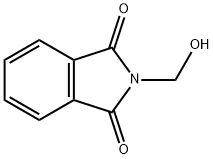
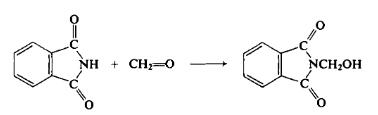
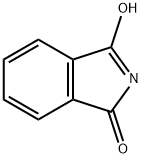
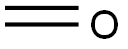
1. 3-Hydroxy-1H-isoindol-1-one (41.14 g, 0.30 mol) was stirred with distilled water (100 mL) for 10 minutes at room temperature. Subsequently, 40% formaldehyde solution (27 mL, 0.36 mol) was added and the mixture was refluxed for 1.5 hours. After completion of the reaction, it was cooled to 0-5 °C, the precipitate was collected by filtration, washed with cold water (0-5 °C, 200 mL) and dried in air to give N-hydroxymethylphthalimide (51.01 g, 96% yield).
2. In another reaction, a solution of thionyl chloride (23.0 mL, 37.7 g, 0.32 mol) in dichloromethane (50 mL) was slowly added to a mixture of N-hydroxymethylphthalimide, dichloromethane (550 mL) and N,N-dimethylformamide (350 mL). After stirring for 30 minutes at room temperature, stirring was continued for 2 hours. Cooled to 0 °C, water (200 mL) was slowly added and neutralized with saturated aqueous NaHCO3 to pH 6.7-7.0. The organic layer was separated, dried over anhydrous magnesium sulfate, the solvent was evaporated under reduced pressure, and the residue was washed with n-hexane (100 mL) to afford N-chloromethylphthalimide (51.4 g, 93% yield).
3. N-Chloromethylphthalimide (51.0 g, 0.26 mol) was dissolved in acetone (500 mL), and potassium O-ethylxanthate (43.9 g, 274 mmol) was added in batches under cooling in an ice-water bath. After stirring at room temperature for 10 hours, the solvent was removed and the residue was dissolved in dichloromethane, washed with water and dried over sodium sulfate. The solvent was removed under reduced pressure to give a light yellow solid, which was recrystallized from ethyl acetate to give the target product (67.2 g, 92% yield) with a melting point of 99-100 °C.
1H NMR (CDCl3, 400 MHz) δ: 1.47 (t, J = 7.1 Hz, 3H, CH3), 4.68 (q, J = 7.1 Hz, 2H, CH2), 5.34 (s, 2H, CH2), 7.75 (dd, J = 5.5, 3.1 Hz, 2H, ArH), 7.88 (dd, J = 5.5, 3.1 Hz. 2H, ArH).
13C NMR (CDCl3, 100 MHz) δ: 13.7, 41.2, 70.5, 123.6, 131.8, 134.4, 166.6, 210.2.