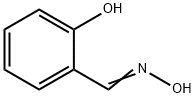
Salicylaldoxime is recognized as a selective precipitant for copper, although it forms water-insoluble chelates with a number of elements. Ingvar Dahl invested the extraction of divalent magnesium, manganese, cobalt, nickel, copper, zinc, cadmium, mercury, and lead with solutions of salicylaldoxime in benzene and the effect of the reagent concentration and particularly the pH of the aqueous phase on the extractability was also studied. The solubility of salicylaldoxime in organic solvents has been utilized in the solvent extraction of carious elements.
Salicylaldoxime reacts with several metal ions to give intensively coloured
complexes which are insoluble in water. The structure of the copper(II), nickel(II)
and palladium(II) complexes is shown in Fig. 14 (structure I), and that of the
manganese(II), iron(II), cobalt(II) and zinc(II) complexes in Fig. 14 (structure
II). The copper(Il) and palladium(II) salicylaldoxime complexes are of importance
from an analytical point of view. The complexes precipitated from aqueous
media are easily filterable and washable and are weighed after drying at 100°C.
The precipitates are of stoichiometric composition.
The outstanding stabilities of the copper(II) and palladium(II) complexes
make the reagent suitable for the selective determination of these metal ions.
These two complexes form quantitatively at low pH values where the complexes
of other metal ions do not exist.
Besides the gravimetric method, salicylaldoxime is also useful in the volumetric,
amperometric and nephelometric determinations of copper and palladium.
Salicylaldoxime gives a black precipitate with VOs~ in media containing sulfuric
acid; this is soluble in chloroform to give an orange solution. The reaction is
specific for vanadium which can thus be detected by this method in the presence
of almost all other metals.
In neutral medium salicylaldoxime reacts with iron(III) to give a red complex
which is soluble in water. The reaction is utilized for the detection of micro
amounts of iron.
[1] Journal fuer Praktische Chemie (Leipzig), 1989, vol. 331, # 5, p. 870 - 872
[2] Journal of the Iranian Chemical Society, 2010, vol. 7, # 1, p. 114 - 118
[3] Patent: CN103864754, 2016, B. Location in patent: Paragraph 0378; 0379
[4] Chemical Communications, 2014, vol. 50, # 56, p. 7531 - 7534
[5] Revue Roumaine de Chimie, 2015, vol. 60, # 9, p. 875 - 880