
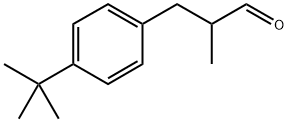
3-(4-tert-ブチルフェニル)イソブチルアルデヒド
化学名:3-(4-tert-ブチルフェニル)イソブチルアルデヒド
CAS番号.80-54-6
英語名:Lily aldehyde
CBNumberCB2492379
MFC14H20O
MW204.31
MOL File80-54-6.mol
别名
3-(4-tert-ブチルフェニル)イソブチルアルデヒド
4-tert-ブチル-α-メチルベンゼンプロパナール
2-メチル-3-(4-tert-ブチルフェニル)プロパナール
more
3-(4-tert-ブチルフェニル)イソブチルアルデヒド物理性質
| 融点 | −20 °C (−4 °F; 253 K) |
| 沸点 | 275 °C (527 °F; 548 K) |
| 比重(密度) | 0.94 g/cm3 |
| 蒸気圧 | 0.25Pa at 20℃ |
| 屈折率 | 1.50 |
| 闪点 | 100 °C |
| 貯蔵温度 | 2-8°C |
| 溶解性 | Chloroform (Sparingly), Ethyl Acetate (Slightly) |
| 外見 | Clear viscous liquid |
| 色 | Colorless to Light yellow |
| 臭い (Odor) | 100.00%で。フローラル ミュゲ ウォータリー グリーン パウダリー クミン |
| においのタイプ | 花柄 |
| 水溶解度 | 33mg/L at 20℃ |
| BRN | 880140 |
| Henry's Law Constant | 5.7×10⁻¹ mol/(m3Pa) at 25℃, Dupeux et al. (2022) |
| 主な用途 | 洗浄剤 化粧品 食品および飲料 パーソナルケア |
| 化粧品成分の機能 | 香料 香料 |
| InChI | 1S/C14H20O/c1-11(10-15)9-12-5-7-13(8-6-12)14(2,3)4/h5-8,10-11H,9H2,1-4H3 |
show more
| 主な危険性 | Xn,N |
| Rフレーズ | 22-38-51/53-62-43 |
| Sフレーズ | 60-61-36/37 |
| RIDADR | UN 3082 9/PG 3 |
| WGK Germany | 2 |
| RTECS 番号 | MW4895000 |
| F | 10 |
| TSCA | TSCA listed |
| HSコード | 2912190090 |
| ストレージクラス | 6.1C - Combustible acute toxic Cat.3 toxic compounds or compounds which causing chronic effects |
| Hazard Classifications | Acute Tox. 4 Oral Aquatic Chronic 3 Repr. 1B Skin Irrit. 2 Skin Sens. 1 |
| 消防法 | 危-4-3-III |
| 化審法 | (3)-2667 優先評価化学物質 |
| 危険度評価(NFPA 704基準/消防庁データ) | 人的[青]=0 |


3-(4-tert-ブチルフェニル)イソブチルアルデヒド 化学特性,用途語,生産方法
このような結果となっており、化粧品配合量および通常使用下の中で非感作性になるよう配合される場合において一般に安全性に問題のない成分であると考えられます。
化学的特性
Lily aldehyde is a homolog of cyclamenaldehyde. The racemic compound is a colorless to slightly yellow liquid with a mild-floral odor, reminiscent of cyclamen and lily of the valley.The aldehyde is prepared by the same routes as cyclamenaldehyde.
Other routes start from -methylcinnamaldehyde. -Methylcinnamaldehyde (from benzaldehyde and propionaldehyde) is hydrogenated to -methyldihydrocinnamic alcohol.The alcohol is alkylated with tert-butyl chloride or isobutene to 4-tert-butyl--methyldihydrocinnamic alcohol, which is subsequently dehydrogenated to the desired aldehyde.
4-tert-Butyl--methyldihydrocinnamaldehyde is more stable than cyclamenaldehyde and is a popular component of flower compositions, particularly lily of the valley and linden types, because of its mild, pleasant, blossomfragrance. It is used in a wide range of perfume types, but especially in soap and detergent perfumes.
使用
In addition to its applications in the perfume and aroma industry, lilial is used mainly for the synthesis of substituted 3-(4-tert-butylphenyl)-2-methylpropylamines, a new class of substances with fungicidal properties. These compounds are effective against mildew in barley and wheat.調製方法
Lily aldehyde is produced industrially almost solely by aldol condensation of 4-tert-butylbenzaldehyde and propionaldehyde to give 4-tert-butyl-α-methylcinnamaldehyde, which can be hydrogenated selectively on noble metal catalysts such as Pd, Rh, Pd – Pr2O3 on Al2O3, or on modified cobalt catalysts. The aldol condensation and the hydrogenation can be carried out in one step in the presence of a hydrogenation catalyst.The Friedel – Crafts reaction of 4-tertbutylbenzene with methacrolein or methacrolein diacetate proceeds in an analogous manner to the preparation of cyclamenaldehyde.
Further possibilities are the Rh-catalyzed hydroformylation of 1-(4-tert-butylphenyl)-1- methoxypropene and subsequent partial hydrogenation, the palladium salt catalyzed reaction of 4-tert-butylphenylhalide with methallylalcohol, and the dehydrogenation of 3-(4-tert-butylphenyl)-2-methylpropanol on silver catalysts.
一般的な説明
2-(4-tert-Butylbenzyl)propionaldehyde is categorized under the synthetic fragrance class of compounds widely utilized in consumer products such as perfumes, after shave lotions, cosmetics, etc.製品名
Lilestralis Pure (Innospec), Lysmeral® Extra (BASF).接触アレルゲン
Lilial is a synthetic compound listed as a fragrance allergen. Its presence is indicated on cosmetics within the EU.参考文献
- 日本化粧品工業連合会編(2013)「ブチルフェニルメチルプロピオナール」日本化粧品成分表示名称事典 第3版,842.
- ⌃有機合成化学協会編(1985)「p-t-ブチル-α-メチルヒドロシンナムアルデヒド」有機化合物辞典,833-834.
- ⌃堀内 哲嗣郎(2010)「香料業界で用いる専門用語」香り創りをデザインする -調香の基礎からフレグランスの応用まで-,32-38.
- 奥田 治, 他(2000)「香調の表現および分類」香料と化粧品の科学,51-53.
- 丸山 賢次, 荒井 綜一, 他編(2000)「香りを分類するための用語と表現」最新 香料の事典,166-172.
- 兼井 典子(2003)「香りの化学」化学と教育(51)(2),86-88. DOI:10.20665/kakyoshi.51.2_86.
- 長谷川香料株式会社(2013)「フレグランスの分類と原料」香料の科学,124-127.