
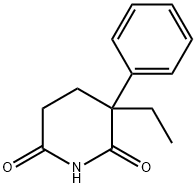
DL-Glutethimide
- Product NameDL-Glutethimide
- CAS77-21-4
- CBNumberCB6399670
- MFC13H15NO2
- MW217.26
- EINECS201-012-0
- MDL NumberMFCD00056091
- MOL File77-21-4.mol
Chemical Properties
| Melting point: | 84°C |
| Boiling point: | 357.82°C (rough estimate) |
| Density | 1.0960 (rough estimate) |
| refractive index | 1.5300 (estimate) |
| Flash point: | 9℃ |
| storage temp. | -20°C |
| solubility | Chloroform (Slightly), Methanol (Slightly) |
| form | Solid |
| pka | pKa 11.8 (Uncertain) |
| color | Off-White to Light Beige |
| Water Solubility | 0.95g/L(27 ºC) |
| CAS DataBase Reference | 77-21-4(CAS DataBase Reference) |
| NIST Chemistry Reference | Glutethimide(77-21-4) |
Safety
| Symbol(GHS) |
   GHS02,GHS06,GHS08 |
| Signal word | Danger |
| Hazard statements | H225-H301+H311+H331-H370 |
| Precautionary statements | P210-P260-P280-P301+P310-P311 |
| Hazard Codes | Xn,T,F |
| Risk Statements | 22-39/23/24/25-23/24/25-11 |
| Safety Statements | 36-45-36/37-16-7 |
| RIDADR | 3249 |
| WGK Germany | 1 |
| RTECS | MA4725000 |
| HazardClass | 6.1(b) |
| PackingGroup | III |
| HS Code | 2925120000 |
| Hazardous Substances Data | 77-21-4(Hazardous Substances Data) |
| Toxicity | Glutethimide, and a structurally similar compound methyprylon, has been used occasionally as a sedative-hypnotic, although glutethimide’s use for longer than 3 days is not recommended and it is rarely, if ever, prescribed today. Glutethimide causes a skin rash in nearly 10% of those using it, and although it was once thought to produce less respiratory depression than the barbiturates its overdose fatality record is not good. Much of the drug’s action can be attributed to 4-hydroxyglutethimide, which is more than twice as potent and has a long half-life. Like many other sedativehypnotics, abrupt withdrawal after chronic use or abuse resembles that of ethanol or the barbiturates and must be managed accordingly. |