Uses
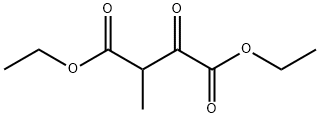
Diethyl Oxalopropionate is a useful precursor in the synthesis of 2-Methylcitric Acid (M265080); a metabolite of Citric Acid (C521000) that can also be formed from condensation of propionoyl-CoA and oxaloacetic acid catalyzed by a citrate synthase enzyme.
Uses
Reactant involved in:• ;Synthesis of anticancer and antiviral agents1• ;Oxidation by organohypervalent iodine reagent2• ;Synthesis of monomers for preparation of functional polyesters3• ;Synthesis of calpain inhibitors4• ;Preparation of human A2A receptor antagonists5• ;Structural studies of dihydropteroate synthase inhibitors6
Uses
Reactant involved in:
- Synthesis of anticancer and antiviral agents
- Oxidation by organohypervalent iodine reagent
- Synthesis of monomers for preparation of functional polyesters
- Synthesis of calpain inhibitors
- Preparation of human A2A receptor antagonists
- Structural studies of dihydropteroate synthase inhibitors
Definition
ChEBI: Diethyl 2-methyl-3-oxosuccinate is an alpha-ketoester, a beta-ketoester, an ethyl ester and a diester.
Synthesis
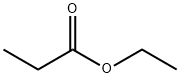
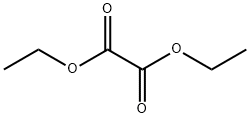
At room temperature, diethyl oxalate (300 g, 2.94 mol) and ethyl propionate (429.4 g, 2.94 mol) were dissolved in 1.8 L of anhydrous ethanol, followed by the addition of sodium ethoxide (300 g, 4.41 mol). The reaction mixture was stirred overnight. After completion of the reaction, the mixture was cooled to room temperature and the pH was adjusted to 7 with 6 N hydrochloric acid. subsequently, the mixture was concentrated under reduced pressure to remove the solvent. The concentrated residue was diluted with water and extracted with ethyl acetate. The organic layers were combined, dried with anhydrous sodium sulfate, filtered and concentrated under reduced pressure to give diethyl oxalylpropionate (400 g, 67% yield) as a red liquid, which could be used in subsequent steps without further purification.1H NMR (400 MHz, CDCl3) δ ppm: 4.103-4.386 (m, 5H); 1.246-1.439 (m, 9H) .
References
[1] Journal of Medicinal Chemistry, 2013, vol. 56, # 23, p. 9701 - 9708
[2] Patent: US2015/25087, 2015, A1. Location in patent: Paragraph 0168; 0237; 0238
[3] Journal of the American Chemical Society, 1946, vol. 68, p. 132
[4] Justus Liebigs Annalen der Chemie, 1888, vol. 246, p. 329
[5] Journal of the Chemical Society, 1924, vol. 125, p. 313