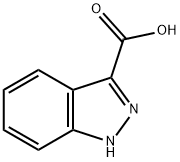
Application
Indazole-3-carboxylic acid is a key synthetic intermediate for the preparation of various indazole derivatives. Its ester derivatives can react with hydrazine hydrate to form acylhydrazines, which in turn react with aldehydes and ketones to form hydrazones. It can act as a ligand to form coordination compounds with biochemical properties [1]. Furthermore, it can replace the traditional indazole-3-carboxylic acid methyl ester as a direct starting material for the synthesis of synthetic cannabinoids (SCs) and their metabolites [2].
References
[1] García-Valdivia, A. A., Jannus, F., García-García, A., Choquesillo-Lazarte, D., Fernández, B., Medina-O’donnell, M., Lupiáñez, J. A., Cepeda, J., Reyes-Zurita, F. J., & Rodríguez-Diéguez, A. (2021). Anti-cancer and anti-inflammatory activities of a new family of coordination compounds based on divalent transition metal ions and indazole-3-carboxylic acid.
Journal of Inorganic Biochemistry,
215, Article 111308.
https://doi.org/10.1016/j.jinorgbio.2020.111308[2] Rautio, T., Connolly, M. J., Liu, H., Konradsson, P., Gréen, H., Dahlén, J., & Wu, X. (2024). Direct and selective alkylation of indazole-3-carboxylic acid for the preparation of synthetic cannabinoids and metabolites.
Forensic Chemistry,
40, Article 100603.
https://doi.org/10.1016/j.forc.2024.100603[3] Buu-Hoi, N. P., Hoeffinger, J. P., & Jacquignon, P. (1964). Indazole-3-carboxylic acids and their derivatives.
Journal of Heterocyclic Chemistry,
1 5, 239–241.
https://doi.org/10.1002/jhet.5570010505