Description
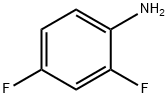
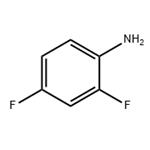
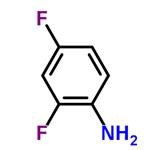
2,4-difluoroaniline is an important intermediate used in organic synthesis, pharmaceuticals agrochemicals, dyes, and agricultural chemicals.
Reference
R. Garth Pews, J. A. Gall, Process and intermediates for the preparation of 2,6-difluoroaniline, Paten US5041674A
Chemical Properties
dark red liquid
Uses
2,4-Difluoroaniline is an important raw material and intermediate used in organic synthesis, pharmaceuticals agrochemicals and dyestuff fields.
General Description
Dark reddish-purple liquid.
Air & Water Reactions
2,4-Difluoroaniline may be sensitive to prolonged exposure to air. . Water soluble.
Reactivity Profile
Amines are chemical bases. They neutralize acids to form salts plus water. These acid-base reactions are exothermic. The amount of heat that is evolved per mole of amine in a neutralization is largely independent of the strength of the amine as a base. Amines may be incompatible with isocyanates, halogenated organics, peroxides, phenols (acidic), epoxides, anhydrides, and acid halides. Flammable gaseous hydrogen is generated by amines in combination with strong reducing agents, such as hydrides.
Health Hazard
ACUTE/CHRONIC HAZARDS: 2,4-Difluoroaniline may be irritating to tissues.
Fire Hazard
2,4-Difluoroaniline is combustible.
Synthesis
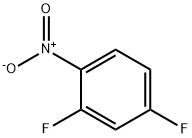
The general procedure for the synthesis of 2,4-difluoroaniline from 2,4-difluoronitrobenzene was as follows: 2,4-difluoro-1-nitrobenzene (1 g), methanol (10 mL), and Pd/C catalyst (100 mg) were added to a 100 mL single-necked reaction flask. Subsequently, the reaction system was replaced three times with hydrogen to remove air. The reaction mixture was stirred at room temperature for 2-3 hours. Upon completion of the reaction, the catalyst was removed by filtration under reduced pressure and the filtrate was concentrated to give 810 mg of the target product 2,4-difluoroaniline.
References
[1] Synthetic Communications, 2012, vol. 42, # 2, p. 213 - 222
[2] Synthesis and Reactivity in Inorganic, Metal-Organic and Nano-Metal Chemistry, 2011, vol. 41, # 1, p. 114 - 119
[3] Journal fuer Praktische Chemie (Leipzig), 1934, vol. <2> 140, p. 97,111
[4] Chemische Berichte, 1937, vol. 70, p. 2396,2400