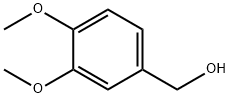
Chemical Properties
Colorless to light yellow liqui
Uses
3,4-Dimethoxybenzyl alcohol is widely used in the synthesis of various cyclotriveratrylenes (CTVs), which are cyclic molecular hosts with a cavity to accommodate guest molecules. It can also be used as a precursor in the total synthesis of salvianolic acid N.
Uses
3,4-Dimethoxybenzyl alcohol used as the fuel of the microbial fuel cell (MFC) to generate power. Veratrole alcohol is the raw material for the synthesis of cyclotriveratrylene which is used in host-guest chemistry.
Uses
3,4-Dimethoxybenzyl Alcohol is a secondary metabolite of some lignin degrading fungi. Recent studies have been conducted to explore whether 3,4-Dimethoxybenzyl Alcohol, a product from the biodegradati
on of lignocellulosic biomass, could be used as the fuel of the microbial fuel cell (MFC) to generate power.
Definition
ChEBI:
(3,4-dimethoxyphenyl)methanol is a member of the class of benzyl alcohols that is benzyl alcohol in which the hydrogens at positions 3 and 4 of the phenyl group are substituted by methoxy groups. It has a role as a fungal metabolite. It is a member of benzyl alcohols, a primary alcohol and a dimethoxybenzene.
General Description
Pharmaceutical secondary standards for application in quality control, provide pharma laboratories and manufacturers with a convenient and cost-effective alternative to the preparation of in-house working standards.
Synthesis
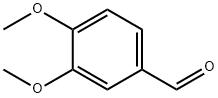
Using 3,4-dimethoxybenzaldehyde as a raw material, reduction is carried out in methanol or other alcohol solvents by adding sodium borohydride (a mild reducing agent commonly used in industry), with the reaction stirred at room temperature to reflux temperature; or in the laboratory, lithium aluminum hydride (in anhydrous tetrahydrofuran or diethyl ether) can be used for reduction. After the reaction is completed, the product 3,4-dimethoxybenzyl alcohol is obtained by acidification, extraction, drying, distillation or recrystallization.