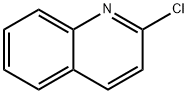
Chemical Properties
white to yellowish crystals, powder, chunks or
Uses
2-Chloroquinoline is an important raw material and intermediate used in organic synthesis, pharmaceuticals, agrochemicals and dyestuff. It reacts with benzotriazole, followed by cyclization with loss of nitrogen, gives the indolo[2,3-b]quinoline ring system for use in novel cytotoxic DNA topoisomerase II inhibitors.
Uses
2-Chloroquinoline is an intermediate used in the synthesis of various compounds that exhibits antifungal properties.
Synthesis
In a dry four-necked reaction flask add 20mL of dichloromethane, add 2.175g (15mmol) of quinoline N-oxide, turn on the stirring, cool to 0C add 3.035g (30mmol) of triethylamine, the temperature of the system is controlled below -5C, add 0.438g (7.5mmol) of sodium chloride, 1.305g (0.75mmol) of sodium conidiosulfate and 0.136g (0.6mmol) benzyltriethylammonium chloride, continue to lower the temperature to below -10 , dropwise add 8mL of dichloromethane solution containing 2.222g (7.5mmol) bis (trichloromethyl) carbonate, and the reaction was carried out at this temperature for 6h. At the end of the reaction, the reaction was quenched by adding 10mL of deionized water, the layers were separated and the organic phase was washed with 10mL of a 10% sodium hydroxide solution, then with 10mL of deionized water, and the organic phase was washed with 10mL of 10% sodium hydroxide solution. The organic phase was washed with 10 mL of 10% sodium hydroxide solution, then washed with 10 mL of deionized water, and finally the aqueous phase was extracted with (15 mL*2) dichloromethane, and the organic layers were combined, dried with anhydrous MgSO4, and concentrated to obtain the crude product. After purification by column chromatography, 1.501g of product was obtained with 61.4% yield.
Purification Methods
Purify it by crystallisation of its picrate to constant melting point (123-124o) from *benzene, regenerating the base and distilling it under vacuum [Cumper et al. J Chem Soc 1183 1962]. 2-Chloroquinoline can be crystallised from EtOH. Its picrate has m 123-124o (from EtOH). [Beilstein 20 H 359, 20/7 V 312.]