Uses
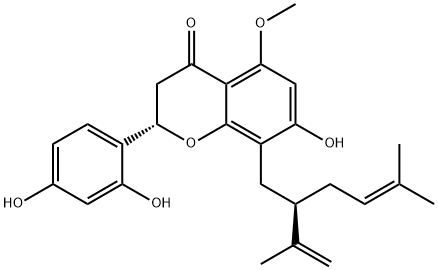
Kurarinone is an orally active flavonoid isolated from matrine that inhibits the pathogenesis of experimental autoimmune encephalomyelitis by inhibiting cell differentiation of Th1 and Th17. Kurarinone has antitumor and anti-inflammatory activity[1][2][3].
Definition
ChEBI: (2S)-(-)-kurarinone is a trihydroxyflavanone that is (2S)-flavanone substituted by hydroxy groups at positions 7, 2' and 4', a lavandulyl group at position 8 and a methoxy group at position 5. Isolated from the roots of Sophora flavescens, it exhibits cytotoxicity against human myeloid leukemia HL-60 cells. It has a role as a metabolite and an antineoplastic agent. It is a trihydroxyflavanone, a monomethoxyflavanone and a member of 4'-hydroxyflavanones. It is functionally related to a (2S)-flavanone.
Biological Activity
Kurarinone, a flavonoid isolated from Sophora flavescens, inhibits the pathogenesis of experimental autoimmune encephalomyelitis by inhibiting the differentiation of Th1 and Th17 cells.
Physiological effects
Kurarinon has an anti-endothelial cell proliferative activity, and it has a significant inhibitory effect on endothelial cell proliferation with a median inhibitory concentration (IC50) of 12ug/ml.
in vivo
Kurarinone (100 mg/kg, oral, days 21-42) has therapeutic effects in a collagen-induced arthritis (CIA) mouse model[3].
Kurarinone (100 mg/kg, po, from day 21-42) has a therapeutic effect in a mouse model of collagen-induced arthritis (CIA)[3].
| Animal Model: | CIA Mouse Model[3] |
| Dosage: | 100 mg/kg |
| Administration: | po |
| Result: | Reduced the levels of proinflammatory cytokines, TNF-α, IL-6, IFN-γ, and IL-17A.
Reduced STAT1 and STAT3 phosphorylation and the proportions of Th1 and Th17 cells in lymph nodes. |
References
[1] Xie L, et al. The flavonoid kurarinone inhibits clinical progression of EAE through inhibiting Th1 and Th17 cell differentiation and proliferation. Int Immunopharmacol. 2018 Sep;62:227-236. DOI:
10.1016/j.intimp.2018.06.022[2] Nishikawa S, et al. Kurarinone from Sophora Flavescens Roots Triggers ATF4 Activation and Cytostatic Effects Through PERK Phosphorylation. Molecules. 2019 Aug 27;24(17):3110. DOI:
10.3390/molecules24173110[3] Tang KT, et al. Kurarinone Attenuates Collagen-Induced Arthritis in Mice by Inhibiting Th1/Th17 Cell Responses and Oxidative Stress. Int J Mol Sci. 2021 Apr 13;22(8):4002. DOI:
10.3390/ijms22084002