Chemical Properties
Yellow crystalline powder, soluble in organic solvents such as methanol, ethanol, and DMSO. It is derived from the fruit of Camptotheca acuminata Decne., a plant of the Davidiaceae family.
Uses
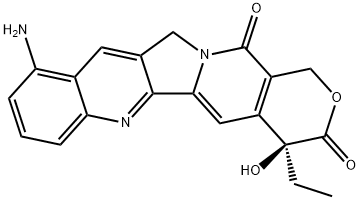
9-Amino Camptothecin is a derivative of Camptothecin (C175150), as antitumor agent.
Definition
ChEBI: 9-Aminocamptothecin is a pyranoindolizinoquinoline.
Biological Activity
9-amino camptothecin is a topoisomerase i inhibitor [1][2].dna topoisomerases relax dna torsional strain generated during replication, transcription, recombination, repair, and chromosome condensation. the relaxation of dna supercoiling by topoisomerase i is enabled by a mechanism of controlled rotation around a transient dna single-strand break. camptothecin (cpt) is isolated from the bark of the chinese tree camptotheca accuminata [3].9-amino camptothecin, a water-soluble camptothecin analogue, is a topoisomerase i inhibitor. in human ht-29 colon adenocarcinoma, 9-amino camptothecin (9-ac) exhibited cytotoxicity with ic50 value of 19 nm. 9-ac also induced dna damage in whole cells and nuclei at a concenstration of 85 nm and 21 nm, respectively [1].9-amino camptothecin had greater activity than camptothecin against human tumour xenografts, including lewis lung carcinoma and b16 melanoma. 9-ac had entered phase ii trials. in patients with advanced solid tumours, 9-amino camptothecin exhibited anti-tumor activity [1][2].
in vivo
9-Aminocamptothecin (9-Amino-CPT) inhibits tumor growth at the lowest oral dose (0.35 mg/kg/day), whereas higher oral doses (0.75 and 1 mg/kg/day) and s.c. administration (4 mg/kg/week) causes tumor regression. 9-Aminocamptothecin is well tolerated at all doses, with no toxic death or weight loss of more than 10% observed in any group[2]. 9-Aminocamptothecin induces complete remissions in 55 % of SCID mice engrafted with human myeloid leukemia. The oral and intravenous routes are equally effective. The results with this pre-clinical model support the evaluation of 9-Aminocamptothecin as antileukemic agent in a phase I trial in patients with AML[3].
References
[1]. rothenberg, m.l. topoisomerase i inhibitors: review and update. annals of oncology 8(9), 837-855 (1997).
[2]. dancey j, eisenhauer ea. current perspectives on camptothecins in cancer treatment. br j cancer. 1996 aug;74(3):327-38.
[3]. drwal mn1, agama k, wakelin lp, et al. exploring dna topoisomerase i ligand space in search of novel anticancer agents. plos one. 2011;6(9):e25150.