Description
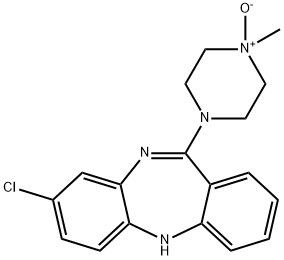
Clozapine-N-oxide (34233-69-7) is a clozapinemetabolite1which is pharmacologically inert2. Agonist at human muscarinic designer receptors known as DREADDs, (designer receptors exclusively activated by designer drug).2May be used to control grafted human pluripotent stem cell-derived neurons engineered to express DREADDs.3,4Numerous other applications.5,6
Chemical Properties
Yellow Solid
Uses
Clozapine N-oxide has been used:
- for the activation of human M4 muscarinic (hM4Di) in primary motor cortex
- for inducing in vivo chemogenetic manipulation and impairing locomotor activity in Th-cre transgenic mice
- in behavioral testing in mice and for stimulating (HEK293) cells
Uses
A 5-HT2 antagonist. A major metabolite of clozapine that can be monitored by HPLC. Possesses little or no activity towards serotonin receptors
Definition
ChEBI: Clozapine N-oxide is a dibenzodiazepine.
General Description
Clozapine N-oxide (CNO), inactive from of clozapine drug, activates G-protein-coupled receptors (GPCRs). CNO serves as a synthetic ligand for engineered human muscarinic receptor. It elicits clozapine-like effects upon metabolic conversion. Clozapine conversion to CNO favors its passage through blood-brain barrier.
Biochem/physiol Actions
5-HT2 serotonin receptor antagonist; major metabolite of clopazine that can be monitored by HPLC.
storage
Room temperature (desiccate)
References
[1] BIRGIT EIERMANN. The involvement of CYP1A2 and CYP3A4 in the metabolism of clozapine[J]. British journal of clinical pharmacology, 2003, 44 5: 439-446. DOI:
10.1046/j.1365-2125.1997.t01-1-00605.x[2] BLAINE N ARMBRUSTER. Evolving the lock to fit the key to create a family of G protein-coupled receptors potently activated by an inert ligand.[J]. Proceedings of the National Academy of Sciences of the United States of America, 2007: 5163-5168. DOI:
10.1073/pnas.0700293104[3] YUEJUN CHEN. Chemical Control of Grafted Human PSC-Derived Neurons in a Mouse Model of Parkinson’s Disease.[J]. Cell stem cell, 2016, 18 6: 817-826. DOI:
10.1016/j.stem.2016.03.014[4] ELENA M VAZEY Gary A J. Designer receptors: therapeutic adjuncts to cell replacement therapy in Parkinson’s disease.[J]. Journal of Clinical Investigation, 2014, 124 7: 2858-2860. DOI:
10.1172/jci76833[5] JUAN L. GOMEZ. Chemogenetics revealed: DREADD occupancy and activation via converted clozapine[J]. Science, 2017, 357 6350. DOI:
10.1126/science.aan2475[6] CATHERINE A. MARCINKIEWCZ. Serotonin engages an anxiety and fear-promoting circuit in the extended amygdala[J]. Nature, 2016, 537 7618: 97-101. DOI:
10.1038/nature19318