Description
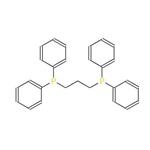
1,3-Bis(diphenylphosphino)propane is a ligand for metal-catalyzed substitution reactions of aryl and vinyl triflates, halides, and carbonates; carbonylation reactions; Grignard coupling; diene alkylation; macrocycle synthesis.
Chemical Properties
white to light yellow crystal powde
Uses
1,3-Bis(diphenylphosphino)propane is used as a bidentate ligand in coordination chemistry and form complex dichloro(1,3-bis(diphenylphosphino)propane)nickel by reacting with nickel(II) chloride. This complex is used as a catalyst for Kumada coupling reaction. It also acts as a ligand for palladium(II) catalysts which is useful for the co-polymerization of carbon monoxide and ethylene to get polyketones. Further, it is employed in palladium-catalyzed arylation under Heck reaction and Suzuki reaction. In addition to this, it serves as a catalyst for Negishi coupling and Sonogashira coupling reactions.
reaction suitability
reagent type: ligand
reaction type: C-C Bond Formation
reagent type: ligand
reaction type: Carbonylations
reagent type: ligand
reaction type: Negishi Coupling
reagent type: ligand
reaction type: Sonogashira Coupling
reagent type: ligand
reaction type: Suzuki-Miyaura Coupling
Synthesis
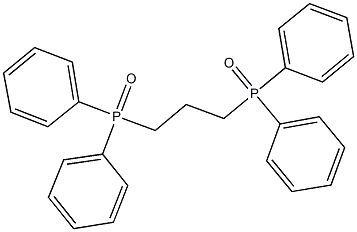
GENERAL METHODS: In a sealed tube, the phosphine oxide derivative (5 mmol) was dissolved in anhydrous toluene (1 M), followed by the addition of InBr3 (1 mol%, 0.05 mmol) and TMDS (1.5 equiv, 7.5 mmol). Depending on the substrate, the reaction mixture was stirred at 100 °C for 7 to 40 h (the progress of the reaction was monitored by 31P NMR). Once the reaction was complete, toluene was removed by evaporation and the product was purified by rapid chromatography on silica gel, using pure cyclohexane as eluent, to give the final target product 1,3-bis(diphenylphosphino)propane.
References
[1] Organometallics, 2014, vol. 33, # 21, p. 6171 - 6178
[2] Synlett, 2007, # 10, p. 1545 - 1548
[3] Journal of the American Chemical Society, 2012, vol. 134, # 44, p. 18325 - 18329
[4] Tetrahedron, 2012, vol. 68, # 15, p. 3151 - 3155
[5] Advanced Synthesis and Catalysis, 2016, vol. 358, # 1, p. 26 - 29