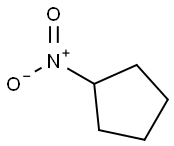
Application
Nitroalkanes are primarily used as raw materials for organic synthesis, solvents, and explosives, and can produce nearly 2,000 derivatives. Their applications span various sectors of the national economy, including pharmaceuticals, pesticides, explosives, dyes, reagents, solvents, surfactants, extractants, emulsifiers, and lubricants. The condensation of nitroalkanes with aldehydes, followed by reduction, yields many versatile amino alcohols, representing one of the most valuable industrial applications of nitroalkanes.
Chemical Properties
Clear pale yellow liquid
Uses
Nitrocyclopentane, a secondary nitroalkane, was examined for its ability to induce DNA repair in rat hepatocytes
. The nitronate of nitrocyclopentane was mutagenic in Salmonella strains TA100 and TA102
.
Preparation
Bromocyclopentane (22.0 g, 0.15 mol) was added to a soln of NaNO2 (18 g, 0.26 mol) in dry DMSO (100 mL) at 15 ℃ and the mixture was stirred at this temperature for 3 h. The mixture was poured into ice water (250 mL) and extracted with petroleum ether (bp 35-37 ℃; 4 × 50 mL). The combined organic extracts were washed with H2O (4× 50 mL), dried (MgSO4), and concentrated under reduced pressure. The residue was distilled to give Nitrocyclopentane; yield: 9.9 g (58%); bp 62 ℃/8 Torr; nD/20 1.4538.
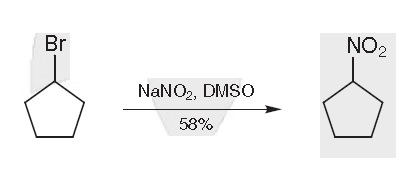
Synthesis of Nitrocyclopentane
General Description
Nitrocyclopentane, a secondary nitroalkane, was examined for its ability to induce DNA repair in rat hepatocytes. The nitronate of nitrocyclopentane was mutagenic in Salmonella strains TA100 and TA102.