Description
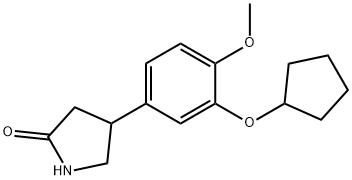
Rolipram (61413-54-5) is a selective inhibitor of cAMP-specific phosphodiesterase (PDE4), IC50 = 1 μM. Displays beneficial effects in neurodegenerative diseases. Rolipram also displays anti-inflammatory activity and synergizes with forskolin (cat.# 10-2073). Cell permeable.
Chemical Properties
Yellowish solid
Uses
(±)-Rolipram is a cAMP-specific phosphodiesterase 4 (PDE4) inhibitor.
Uses
Pharmacological tool for characterization of phosphodiesterase isoenzymes.
Uses
A selective, cell permeable inhibitor of cAMP-specific phosphodiesterase (PDE4).
Definition
ChEBI: Rolipram is a member of the lclass of pyrrolidin-2-ones that is pyrrolidin-2-one bearing a 3-(cyclopentyloxy)-4-methoxyphenyl substituent at the 4-position. It is a type IV-specific phosphodiesterase (PDE4) inhibitor. It has a role as an antidepressant and an EC 3.1.4.* (phosphoric diester hydrolase) inhibitor.
General Description
A cell-permeable, selective inhibitor of cAMP-specific phosphodiesterase (PDE IV; IC
50 = 800 nM). A rolipram-insensitive PDE IV subtype is also known to exist. Also inhibits NF-κB and NFAT activation in Jurkat and primary T cells.
Biological Activity
Selective inhibitor of cAMP phosphodiesterase (PDE4) (IC 50 = 2.0 μ M). Discriminates between two conformational states of PDE4 isoenzymes. See separate isomers ((R)-(-)-Rolipram and (S)-(+)-Rolipram).
Biochem/physiol Actions
Cell permeable: yes
Background
The small-molecule Rolipram is an inhibitor of phosphodiesterase 4, which catalyzes the hydrolysis of cyclic-AMP to regulate cellular responses to a number of extracellular signals. Rolipram inhibits multiple isozymes of PDE4, including PDE4A, PDE4B, and PDE4D. Treatment of myeloid cells with Rolipram resulted in phosphorylation of cAMP-response element-binding protein and implied the presence of both high and low affinity components. Rolipram and other phosphodiesterase inhibitors were seen as having potential therapeutic benefits in preclinical models of psychiatric and neurologic diseases. Unfortunately, severe dose-limiting side effects limited the clinical application of PDE inhibitors. Still, Rolipram treatment in a mouse model of intracerebral hemorrhage demonstrated some neuroprotective benefits through activation of the cAMP/AMPK/SIRT1 pathway. Rolipram treatment of fibroblasts from ligamentum flavum hypertrophy patients inhibited PDE4A and PDE4B activity, blocked TGF-β1 by restoring p-ERK1/2 expression, and inhibited expression of fibrosis-related proteins.
References
[1] M L REEVES P J E B K Leigh. The identification of a new cyclic nucleotide phosphodiesterase activity in human and guinea-pig cardiac ventricle. Implications for the mechanism of action of selective phosphodiesterase inhibitors.[J]. Biochemical Journal, 1987, 241 2: 535-541. DOI:
10.1042/bj2410535[2] AKINORI NISHI. Distinct roles of PDE4 and PDE10A in the regulation of cAMP/PKA signaling in the striatum.[J]. Journal of Neuroscience, 2008, 28 42: 10460-10471. DOI:
10.1523/jneurosci.2518-08.2008[3] S.H. CHRISTIANSEN . Combined anti-inflammatory effects of β2-adrenergic agonists and PDE4 inhibitors on astrocytes by upregulation of intracellular cAMP[J]. Neurochemistry international, 2011, 59 6: Pages 837-846. DOI:
10.1016/j.neuint.2011.08.012