Description
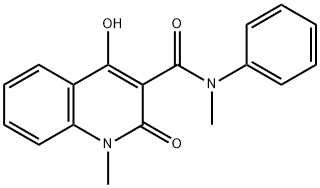
Roquinimex is an immunomodulator with diverse biological activities.
In vivo, roquinimex (80 mg/kg) increases the number of myocardial MHC class II-expressing cells, the ratio of cytotoxic to helper T cells, and survival and decreases necrotic lesion area in a mouse model of murine coxsackievirus B3-induced myocarditis. It induces IFN-γ production, reduces TNF-α and IL-1β production, prevents the development of proteinuria, and ameliorates nephritis in a mouse model of chronic graft versus host disease (GVHD). Roquinimex (300 mg/kg) decreases colonic myeloperoxidase (MPO) activity and mucosal damage in a mouse model of colitis induced by dextran sulfate (DSS; ). It also decreases tumor weight and tumor blood flow in a von Hippel-Lindau (VHL) type 2a paraganglioma mouse xenograft model.
Uses
An immunomodulator with antitumour properties. Inhibits T-cell apoptosis in vivo; also inhibits angiogenesis in rats
Uses
Biological response modifier; immunomodulator.
Definition
ChEBI: 4-hydroxy-N,1-dimethyl-2-oxo-N-phenyl-3-quinolinecarboxamide is an aromatic amide.
Biological Activity
Immunomodulator with stimulatory and antitumor properties. Inhibits in vivo apoptosis of T-cells and inhibits angiogenesis in rats in vivo .
References
[1] N. ILBCK. Effects of the immunomodulator LS 2616 on lymphocyte subpopulations in murine Coxsackievirus B3 myocarditis.[J]. Journal of immunology, 1989, 142 9 1: 3225-3228. DOI:
10.4049/jimmunol.142.9.3225[2] ZHI-YONG XIAO. Roquinimex-mediated protection effect on the development of chronic graft-versus-host disease in mice is associated with induction of Th1 cytokine production and inhibition of proinflammatory cytokine production[J]. Life sciences, 2007, 81 19: Pages 1403-1410. DOI:
10.1016/j.lfs.2007.08.044[3] Q LIU. Roquinimex inhibits dextran sodium sulfate-induced murine colitis.[J]. Inflammation Research, 2003, 52 2: 64-68. DOI:
10.1007/s000110300002[4] D J GROSS. The antiangiogenic agent linomide inhibits the growth rate of von Hippel-Lindau paraganglioma xenografts to mice.[J]. Clinical Cancer Research, 1999, 5 11: 3669-3675.