Chemical Properties
It is a white solid, but as it does not crystallise readily, it is usually found in a paste-like form. It is readily soluble in water and ethanol, sparingly soluble in diethyl ether, and its solution is alkaline.
Occurrence
Ornithine is found in many foods, including fish, dairy products and pulses. Sardines, salmon and herring are particularly good sources.
Uses
hepatoprotectant, anticholesteremic
Definition
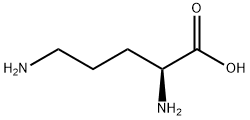
ChEBI: L-ornithine is an optically active form of ornithine having L-configuration. It has a role as a hepatoprotective agent, a mouse metabolite and an algal metabolite. It is an ornithine and a non-proteinogenic L-alpha-amino acid. It is a conjugate base of a L-ornithinium(1+). It is a conjugate acid of a L-ornithinate. It is an enantiomer of a D-ornithine.
Synthesis Reference(s)
Canadian Journal of Chemistry, 31, p. 1060, 1953
DOI: 10.1139/v53-139
Safety Profile
Mutation data reported. When heated to decomposition it emits toxic vapors of NOx.
Purification Methods
Crystallise L-ornithine from water containing 1mM EDTA (to remove metal ions). [Perrin J Chem Soc 3125 1958, Rivard Biochemical Preparations 3 97 1955, Greenstein & Winitz The Chemistry of the Amino Acids J. Wiley, Vol 3 pp 2477-2491 1961, Beilstein 4 III 1346, 4 IV 2644.]