Uses
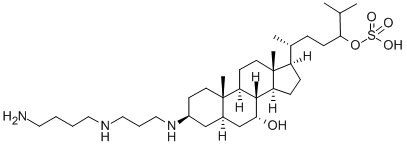
Squalamine is an aminosterol broad-spectrum antibacterial drug present in shark tissue.
Definition
ChEBI: Squalamine is a bile acid.
Biological Activity
Squalamine (MSI-1256) is a compound with broad-spectrum antiviral activity.
Synthesis
Squalamine is isolated from the stomach of spiny horn shark and sea green dog shark.
in vivo
Squalamine (2 mg/kg; Intraperitoneal injection; 28 days) inhibits tumor growth in xenografted mice with breast cancer[2].
Squalamine (20 mg; Single application; 0-3 days) has a decolonizing effect on S. aureus on the skin in a mouse model[3].
Squalamine (20-120 mg/kg; Oral gavage; 5 days) restores the function of the mesenteric nervous system in PD mouse models[4].
| Animal Model: | Female athymic mice aged 6 weeks old bearing breast tumor xenografts[2] |
| Dosage: | 2 mg/kg |
| Administration: | Intraperitoneal injection (i.p.); 28 days |
| Result: | Significantly retarded the growth of tumors, but the combination with Trastuzumab (HY-P9907) was more effective.
Suppressed MCF-7/HER-2 breast xenograft-associated angiogenesis.
|
| Animal Model: | 10 μL S. aureus suspension(108 cfu/mL) was applied to the female BALB/c mice skin[3] |
| Dosage: | 20 mg |
| Administration: | Single application; 3 days |
| Result: | Reduced S. aureus viable cells by up to 4 log after two days compared with the control.
|
| Animal Model: | PD mice models ( hSNCAA53T mice and PrP-A53T human α-syn overexpressing transgenic mice)[4] |
| Dosage: | 20, 40, 80, or 120 mg/kg |
| Administration: | Oral gavage (i.g.); 5 days |
| Result: | Effectively restored disordered colonic motility in PD mice models.
Increased colonic transit in PrP-A53T mice.
Reduced myenteric intrinsic primary afferent neuron excitability in hSNCAA53T mice.
|