Uses
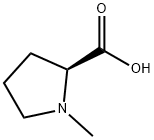
N-Methyl-L-proline, is an aminoacid which is widely used in pharmaceuticals and food industry.
Definition
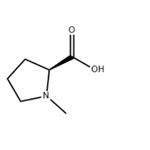
ChEBI: N-methylproline is an L-proline derivative obtained by replacement of the amino hydrogen by a methyl group. It has a role as a plant metabolite and a human metabolite. It is a L-proline derivative and a tertiary amino compound. It is a tautomer of a N-methylproline zwitterion.
Biological Activity
N-Methyl-L-proline is a proline analogue present in citrus fruits.
Synthesis
L-Proline 86 (2.0 g, 17.4 mmol) was dissolved in methanol (20 mL) and to this solution was added 40% aqueous formaldehyde solution (1.4 mL, 19.1 mmol). This was followed by the addition of 10% palladiumon-charcoal catalyst (500 mg) and the resulting slurry was stirred in a hydrogen atmosphere overnight. The slurry was then filtered through a Celite pad to remove the catalyst. The pad was washed with methanol and the combined filtrates were concentrated under reduced pressure. The residue was taken up in ethanol-benzene (1:1, 100 mL) and concentrated a second time to provide a solid, which was recrystallized from methanol-diethyl ether. In this way N-Methyl-L-proline was isolated as fine needles (2.2 g, 98%). Mp 142-145 °C. [α]23 D -78.0° (c 2.0, MeOH). 1H NMR (300 MHz, D2O) δ 3.71-3.65 and 3.55-3.51 (2m, 1H), 3.00-2.91 (m, 1H), 2.74 (s, 3H), 2.34-2.28 (m, 1H), 1.99-1.78 (m, 3H). 13C NMR (75 MHz, CDCl3) δ 173.06, 70.18, 55.83, 40.26, 28.34, 22.37. IR (KBr disk) ν 3000-2800 (CH, saturated), 2675 and 2605 (ammonium ion), 1669 (CO2H), 1612 (CO2 -), 1468, 1401, 1354, 1327, 1234, 1183, 1112, 1056, 1025, 808, 775 cm-1. HRMS calcd for C6H11NO2 (M+) 129.0790, found 129.0784.

References
[1] Journal of Organic Chemistry, 2003, vol. 68, # 7, p. 2652 - 2667
[2] Green Chemistry, 2016, vol. 18, # 16, p. 4374 - 4392
[3] European Journal of Organic Chemistry, 2005, # 5, p. 934 - 938
[4] Tetrahedron Letters, 2007, vol. 48, # 43, p. 7680 - 7682
[5] Medicinal Chemistry Research, 2016, vol. 25, # 6, p. 1148 - 1162