Chemical Properties
White to off-white powder
Uses
Chlorouracil (4-Chlorouracil; 6-Chlorouracil) is a halogenated uracil that is useful in studies of the effects of halogenation on nucleic acid base-pair stability and alkali metal ion affinity. Reaction of 6-chlorouracil with 4-(dimethylamino)pyridine, 4-methylpyridine, and pyridin-4-yl-morpholine yielded pyridinium-substituted uracils as chlorides which were converted into pyridinium uracilates by deprotonation. These heterocyclic mesomeric betaines are cross-conjugated and thus possess separate cationic (pyridinium) and anionic (uracilate) moieties. Calculations and X-ray single crystal analyses may be used to characterize these systems and to compare the salts with the betaines.
Uses
6-Chlorouracil acts as an inhibitor of yeast alcohol dehydrogenase (ADH-H). 6-Chlorouracil is a potential inhibitor of DNA repair glycosylases.
Synthesis
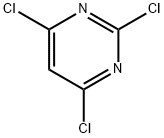
General procedure for the synthesis of 6-chloropyrimidine-2,4(1H,3H)-dione from 2,4,6-trichloropyrimidine: 2,4,6-trichloropyrimidine (10.21 g, 0.56 mol) was dissolved in an aqueous solution (100 mL) containing NaOH (8.9 g, 0.22 mol), which was stirred under refluxing conditions for 1 hour. Upon completion of the reaction, the pH of the reaction mixture was adjusted to 2-3 with concentrated hydrochloric acid. the mixture was placed in a refrigerator overnight to promote crystallization. Subsequently, the precipitate was collected by filtration, washed with cold water and dried under vacuum in the presence of phosphorus pentoxide. 6.43 g (0.54 mol, 97% yield) of 6-chlorouracil was finally obtained as a white crystalline solid. The spectral data of the product were in agreement with those reported in the literature [28] and [40]. Melting point > 280°C. 1H NMR (300 MHz, DMSO-d6) δ (ppm): 12.00 (broad peak, 1H, NH), 11.09 (broad peak, 1H, NH), 5.66 (single peak, 1H, CH). IR (KBr, ν cm-1): 3095 (N-H stretching vibration), 1729,1709,1652 (C=O stretching vibration), 1616 (C=C stretching vibration), 1380 (C-N stretching vibration), 841 (N-H out-of-plane bending vibration), 790 (C-Cl stretching vibration).
References
[1] European Journal of Organic Chemistry, 2008, # 32, p. 5401 - 5406
[2] Journal of Medicinal Chemistry, 2013, vol. 56, # 16, p. 6352 - 6370
[3] European Journal of Medicinal Chemistry, 2012, vol. 54, p. 159 - 174
[4] Organic Letters, 2018, vol. 20, # 2, p. 473 - 476
[5] Heterocycles, 1990, vol. 31, # 9, p. 1641 - 1646