Chemical Properties
White solid
Uses
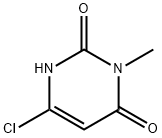
6-Chloro-3-methyluracil have been used in the synthesis of antibacterial agents as inhibitors of Helicobacter pylori glutamate racemase.
Definition
ChEBI: 6-Chloro-3-methyluracil is a member of pyrimidines and an organohalogen compound.
Synthesis
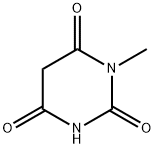
General procedure for the synthesis of 3-methyl-6-chlorouracil from 1-methylpyrimidine-2,4,6(1H,3H,5H)-trione: Water (2.7 mL) was added slowly and dropwise at 0 °C to a 1-methylpyrimidine-2,4,6(1H,3H,5H)-trione (14.2 g, 100 mmol) formed with phosphorus oxychloride (POCl3, 95 mL) in a in a suspension. Subsequently, the reaction mixture was warmed to 80 °C and maintained for 5 hours. Upon completion of the reaction, the resulting brown solution was cooled and the POCl3 was evaporated under reduced pressure.The residue was treated with methanol (MeOH) and the resulting solid was purified by recrystallization from ethanol to give 11.5 g of 3-methyl-6-chlorouracil (yield: 71.6%). The melting point of the product was 279-282 °C (decomposition), which is consistent with literature values (280-282 °C).1H NMR (400 MHz, DMSO-d6) δ 3.10 (s, 3H), 5.90 (s, 1H), 12.4 (br s, 1H).
References
[1] Journal of Heterocyclic Chemistry, 2014, vol. 51, # 3, p. 594 - 597
[2] Tetrahedron Asymmetry, 1997, vol. 8, # 14, p. 2319 - 2323
[3] Patent: WO2009/73210, 2009, A1. Location in patent: Page/Page column 76
[4] Patent: WO2006/133261, 2006, A2. Location in patent: Page/Page column 30
[5] Patent: WO2007/143705, 2007, A2. Location in patent: Page/Page column 23