Chemical Properties
White to light yellow solid
Uses
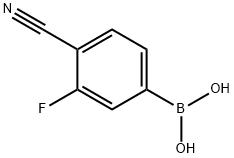
4-Cyano-3-fluorophenylboronic acid serves as a building block for helical polymer nanotubes through dative B−N self-assembly with chiral piperazine or 2-methylpiperazine[2].
Synthesis
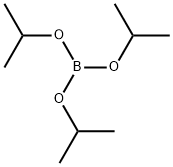
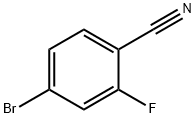
The general procedure for the synthesis of 4-cyano-3-fluorophenylboronic acid from triisopropyl borate and 4-bromo-2-fluorobenzonitrile was as follows: 4-bromo-2-fluorobenzonitrile (200 g, 990 mmol, 1.00 eq.) and triisopropyl borate (228 g, 1188 mmol, 1.2 eq.) were dissolved in a mixture of 700 mL tetrahydrofuran (THF) and 1400 mL toluene solvent. The reaction mixture was cooled to an internal temperature of -75 °C using a dry ice/acetone bath. n-Butyl lithium (n-BuLi, 396 mL of a 2.5 M hexane solution) was added slowly over a period of 2 hours. After the addition was completed, the reaction mixture appeared as a light red slurry. The reaction solution was continued to be stirred at -74 °C for 15 min, followed by a slow warming to -20 °C and the reaction was burst with 1500 mL of 2.5 M hydrochloric acid (HCl) solution. The reaction mixture was allowed to gradually warm up to room temperature (RT). The organic and aqueous layers were separated and the aqueous layer was extracted with ethyl acetate (EtOAc). The organic phases were combined, dried over anhydrous sodium sulfate (Na2SO4), filtered and concentrated under reduced pressure to give a light brown solid. The solid was ground with hexane and transferred to a sintered glass funnel. It was washed again with hexane to give a light yellow filtrate. The light brown solid was mixed with cold dichloromethane (CH2Cl2) and stirred and filtered. The solid was washed with a small amount of dichloromethane to give an off-white solid and a brown filtrate. The solid was dried in a vacuum oven at 40°C to give a final 112 g (679 mmol, 69% yield) of 3-fluoro-4-cyanophenylboronic acid as an off-white solid.
References
[1] Patent: WO2007/87488, 2007, A2. Location in patent: Page/Page column 17; 47-48
[2] Yu, Y., Shen, S.-H., Chen, J.-B., Ding, Q.-R., Zhang, H.-X., & Zhang, J. (2025). Homochiral Single Crystals of Helical Polymer Nanotubes: Synthesis and Application. Journal of the American Chemical Society, 147(24), 20770–20777.
https://doi.org/10.1021/jacs.5c04285