
54739-18-3
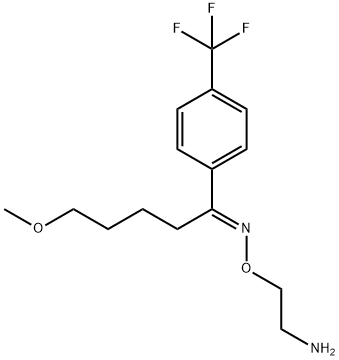
基本信息
氟伏沙明
氟提肟氨
FLUVOXAMINE
(E)-5-methoxy-1-[4-(trifluoromethyl)phenyl]-1-pentanoneo-(2-aminoethyl)oxime
(1E)-5-Methoxy-1-[4-(trifluoromethyl)phenyl]pentanal O-(2-aminoethyl)oxime
(E)-ω-Methoxy-4'-(trifluoromethyl)valerophenone O-(2-aminoethyl)oxime
δ-Methoxy-4'-(trifluoromethyl)valerophenone (E)-O-(2-aminoethyl)oxime
物理化学性质
| 熔点 | 120-122.5°C |
| 沸点 | 370.6±52.0 °C(Predicted) |
| 密度 | 1.16±0.1 g/cm3(Predicted) |
| 储存条件 | Sealed in dry,2-8°C |
| 溶解度 | 可溶于氯仿(少量)、DMSO(少量)、甲醇(少量) |
| 酸度系数(pKa) | pKa 8.7 (Uncertain) |
| 形态 | Oil |
| 颜色 | 无色 |
| InChI | InChI=1S/C15H21F3N2O2/c1-21-10-3-2-4-14(20-22-11-9-19)12-5-7-13(8-6-12)15(16,17)18/h5-8H,2-4,9-11,19H2,1H3/b20-14+ |
| InChIKey | CJOFXWAVKWHTFT-XSFVSMFZSA-N |
| SMILES | C(=N/OCCN)(\C1=CC=C(C(F)(F)F)C=C1)/CCCCOC |
| CAS 数据库 | 54739-18-3(CAS DataBase Reference) |
| NIST化学物质信息 | Fluvoxamine(54739-18-3) |
安全数据
| 危险性符号(GHS) |    GHS07,GHS09,GHS06 |
| 警示词 | 危险 |
| 危险性描述 | H302-H335-H331-H410-H319 |
| 防范说明 | P273-P391-P501-P264-P280-P305+P351+P338-P337+P313P-P261-P271-P304+P340-P311-P321-P403+P233-P405-P501-P264-P270-P301+P312-P330-P501 |
| REACH 注册登记 | Active |
氟伏沙明价格(试剂级)
| 报价日期 | 产品编号 | 产品名称 | CAS号 | 包装 | 价格 |
| 2026/09/15 | HY-B0103R | 氟伏沙明 Fluvoxamine (Standard) | 54739-18-3 | 5 mg | 790元 |
| 2026/09/15 | HY-B0103R | 氟伏沙明 Fluvoxamine (Standard) | 54739-18-3 | 10 mg | 1185元 |
| 2026/09/15 | HY-B0103R | 氟伏沙明 Fluvoxamine (Standard) | 54739-18-3 | 25 mg | 2133元 |
常见问题列表
SSRIs.
Fluvoxamine (DU-23000) is effective in inhibiting 5-ht uptake by blood platelets and brain synaptosomes. The antagonism by fluvoxamine of the reserpine-induced lowering of the pentamethylenetetrazole convulsive threshold can be regarded as due to an effect upon 5-HT uptake. In contrast to the effects of desmethylimipramine and imipramine, no stimulatory effects are found in rats when rapidly acting reserpine-like compounds are given following a dose of fluvoxamine. Fluvoxamine (DU-23000) appears to improve combat-related PTSD symptoms but not depressive symptoms. The high attrition rate and lack of a placebo group limits the conclusions of our study. Controlled studies of fluvoxamine in the treatment of PTSD are warranted. Fluvoxamine (DU-23000) was less potent at decreasing ethanol self-administration when food was available concurrently versus when ethanol was available in isolation [ED50: 4.0 (2.7-5.9) and 5.1 (4.3-6.0)]. Effects on food were similar under each condition in which food was available. The results demonstrate that the potency of fluvoxamine in reducing ethanol-maintained behavior depends on whether ethanol is available in isolation or in the context of concurrently scheduled food reinforcement.