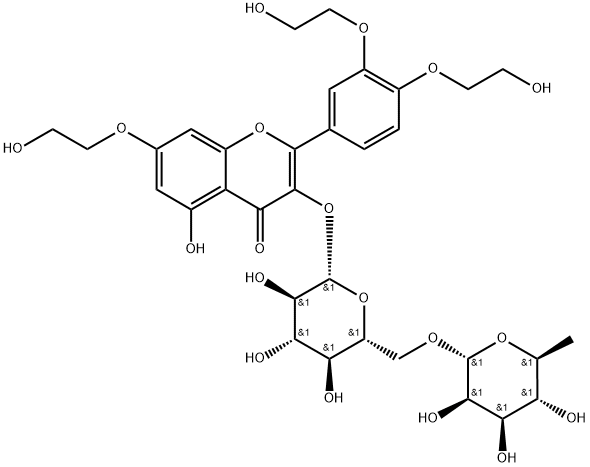
Chemical Properties
Yellow Powder
Originator
Venoruton,Novartis Co
Manufacturing Process
In a nitrogen atmosphere 120 g of caustic soda (3 moles) in solution are
added to 610 g of rutin (1 mol) suspended in 2 litres of water, the mixture
being vigorously agitated by a mechanical stirrer, 241.5 g of ethylene
chlorohydrin being then introduced at 55°C for 10 min. When all the
chlorohydrin has been thus added the temperature is progressively raised to
75°C and maintained at this level for 2 hours. After cooling, in a nitrogen
atmosphere, the pH value adjusted to 5 by the addition of dilute hydrochloric
acid. The solution is kept in an ice box for 24 hours and then filtered to
remove any impurities. At reduced pressure the solution is evaporated until
dry, the residue taken up in 3 litres of boning methanol which dissolves the
tri-(β-hydroxyethyl)rutin formed and leaves the sparingly soluble sodium
chloride behind. The tri-(β-hydroxyethyl)rutin is recovered from its methanolic
solution either by evaporation and refrigeration, or by evaporation
precipitation with absolute ethanol. In either case tri-(β-hydroxyethyl)rutin
obtained is in the form of small very hygroscopic crystals which contain
alcohol of crystallization.These crystals are quickly shaken washed in a little
cold absolute ethanol and then dried in vacuum at 100°C. 680 g of anhydrous
tri-(β-hydroxyethyl)rutin are thus obtained in the form of a yellow powder
which melts at 156°C.GB Patent No. 833,174; April 21, 1960; Assigned to Zyma S.A., a Swiss
Corporation, of Route Etraz, Nyon Canton of Vaud, Switzerland
Therapeutic Function
Topical venotonic
Biological Activity
Troxerutin is a brain penetrantvasoprotective flavonol isolated from Sophora japonicawhich is present in many other plants including grainsfruitsand vegetables. Troxerutin exhibits multiple biological activities including anti-oxidativeanti-radiationand anti-inflammatory. Recent study indicates th at troxerutin improves the synaptic failure induced by Aβ peptide. It appears th at Troxerutin could promote radioprotection by stimulating NEAT1 to upregulate PDPK1 expression by suppressing miR-147.
target
VEGFR | Wnt/β-catenin | NF-kB | SOD | PI3K | Akt
References
[1] Patent: CN104478972, 2017, B. Location in patent: Paragraph 0018; 0019; 0020; 0021; 0022; 0023; 0024-0031
[2] Patent: CN106892950, 2017, A. Location in patent: Paragraph 0018-0026
[3] Chinese Chemical Letters, 2013, vol. 24, # 3, p. 223 - 226
[4] Patent: CN103601772, 2016, B. Location in patent: Paragraph 0011-0014
[5] Patent: CN104447914, 2017, B. Location in patent: Paragraph 0013; 0014