Synthesis
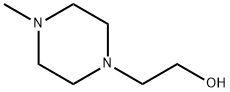
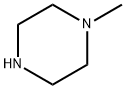
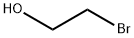
The general procedure for the synthesis of 1-(2-hydroxyethyl)-4-methylpiperazine from N-methylpiperazine and 2-bromoethanol was as follows: 2-bromoethanol (2.36 g, 19 mmol) was added slowly and dropwise to a reaction flask containing a mixture of anhydrous ethanol (150 μL) with 1-methylpiperazine (1.26 g, 13 mmol) and potassium carbonate (5.0 g, 36 mmol). The reaction mixture was heated under reflux conditions for 18 hours. Upon completion of the reaction, the mixture was allowed to cool to room temperature and filtered to remove the insoluble precipitate. Subsequently, the solvent was removed by rotary evaporation. The residue was treated with a solvent mixture of acetone/dichloromethane (v/v ratio not specified), filtered again to remove the insoluble material, and finally the solvent was removed by rotary evaporation to afford 1-(2-hydroxyethyl)-4-methylpiperazine (870 mg, 48% yield) as a light brown oil. The product was confirmed by 1H NMR (CDCl3): δ 2.18 (s, 3H); 2.3-2.7 (br m, 8H); 2.56 (t, 2H); 3.61 (t, 2H).MS-ESI showed a molecular ion peak of 145 [MH]+.
References
[1] Patent: WO2004/7498, 2004, A2. Location in patent: Page 29
[2] ACS Medicinal Chemistry Letters, 2013, vol. 4, # 7, p. 622 - 626
[3] Journal of Medicinal Chemistry, 2017, vol. 60, # 14, p. 6305 - 6320
[4] Patent: US6291455, 2001, B1
[5] Patent: US2003/225111, 2003, A1. Location in patent: Page 41