Synthesis
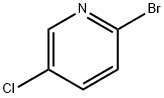
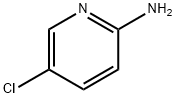
General procedure for the synthesis of 2-bromo-5-chloropyridine from 2-amino-5-chloropyridine: [Ref. Example 25] 5-(5-chloro-2-pyridinyl)-1-(3-pyridinyl)-1H-pyrazole-3-carboxylic acid; [show image] 1) Hydrogen bromide (12 ml, 47% aqueous solution) was slowly added to hydrogen bromide (12 ml, 47% aqueous solution) at 0 °C in a hydrobromic acid containing 2-amino-5-chloropyridine (5 g) ( 50 ml, 47%) solution. Subsequently, a solution of sodium nitrite (15 g) dissolved in water (20 ml) was added dropwise to the reaction mixture. The reaction solution was stirred at 0°C for 1 h. After that, a solution of sodium hydroxide (32 g) in water (80 ml) and ethyl acetate was added for extraction. The organic and aqueous phases were separated and the organic phase was dried over anhydrous sodium sulfate. After filtration, the solvent was removed by concentration under reduced pressure to give 2-bromo-5-chloropyridine (6.8 g, 91% yield) as a white solid. The product was characterized by 1H-NMR (400 MHz, CDCl3): δ 7.44 (1H, d, J = 8.42 Hz), 7.54 (1H, m), 8.36 (1H, s).
References
[1] Chemistry of Heterocyclic Compounds, 2017, vol. 53, # 2, p. 196 - 206
[2] Khim. Geterotsikl. Soedin., 2017, vol. 53, # 2, p. 196 - 206,11
[3] Patent: EP1698626, 2006, A1. Location in patent: Page/Page column 41
[4] Patent: EP1762568, 2007, A1. Location in patent: Page/Page column 24-25
[5] Patent: US5750545, 1998, A