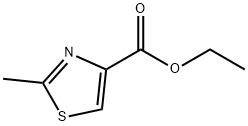
Uses
2-Methyl-1,3-thiazole-4-carboxylic acid serves as a coupling precursor: activated with HATU/DIPEA in DMF, it is condensed with an amine to give the corresponding amide, and with DCC/DMAP/Et3N in CH2Cl2 it is coupled to L-serine methyl ester hydrochloride to form methyl (S)-3-hydroxy-2-{[(2-methyl-1,3-thiazol-4-yl)carbonyl]amino}propanoate[1][2].
References
[1] European Journal of Medicinal Chemistry, 2017, vol. 126, p. 776 - 788
[2] Patent: US2007/105891, 2007, A1. Location in patent: Page/Page column 10
[3] Patent: US2006/160857, 2006, A1. Location in patent: Page/Page column 31
[4] Chemistry of Heterocyclic Compounds, 2011, vol. 47, # 6, p. 703 - 709
[5] Patent: WO2004/58702, 2004, A2. Location in patent: Page 29; 23