Description
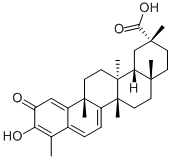
Celastrol (34157-83-0) displays potent antioxidant and anti-inflammatory activity. Inhibits NFkB (IC50=270 nM). ?It induces heat shock response and cytoprotection in various cells. Inhibits 20S proteasome chymotrypsin activity (IC50=2.5 mM). Induces autophagy by targeting AR/miR-101 in prostate cancer cells.4 Induces UPR-dependent cell death in cancer cells.5 Cell permeable.
Chemical Properties
Orange Red Solid
Uses
An antioxidant natural product Celastrol inhibits the growth of human glioma xenografts in nude mice through suppressing VEGFR expression. Used for clinical treatment for rheumatoid arthritis, was demonstrated to have antiangiogenic activity, and be
Uses
antineoplastic, NO synthesis inhibitor, chaperone stimulant
Uses
Celastrol can be used as an antioxidant onstrated to have antiangiogenic activity, and be inhibitory against mice tumor growth by a few recent studies.
Definition
ChEBI: A pentacyclic triterpenoid that is 24,25,26-trinoroleana-1(10),3,5,7-tetraen-29-oic acid bearing an oxo substituent at position 2, a hydroxy substituent at position 3 and two methyl groups at positions 9 and 13. An antioxidant and anti-inflammatory agent.
otently inhibits lipid peroxidation in mitochondria and inhibits TNF-alpha-induced NFkappaB activation. Also shown to inhibit topoisomerase II activity in vitro (IC50 = 7.41 muM).
General Description
This substance is a primary reference substance with assigned absolute purity (considering chromatographic purity, water, residual solvents, inorganic impurities). The exact value can be found on the certificate. Produced by PhytoLab GmbH & Co. KG
Biological Activity
Antioxidant and anti-inflammatory agent. Potently inhibits lipid peroxidation in mitochondria and inhibits TNF- α -induced NF κ B activation. Also shown to inhibit topoisomerase II activity in vitro (IC 50 = 7.41 μ M).
Biochem/physiol Actions
Celastrol is a potent antioxidant, and anti-inflammatory agent. It is a novel HSP90 inhibitor (disrupts Hsp90/Cdc37 complex), that exhibits anticancer (anti-angiogenic - suppresses VEGFR expression); antioxidant (inhibits lipid peroxidation) and anti-inflammatory activity (suppresses iNOS and inflammatory cytokine production).
Synthesis
Celastrol can be prepared by two methods: total chemical synthesis and biosynthesis. The first is the first total chemical synthesis by Camelio et al. (2015), which starts from 2,3-dimethylbutadiene (with a vanillyl-alcohol-derived stannane fragment) and proceeds in ~31 steps: after building a triene precursor via LDA/MeLi/HWE/Wittig transformations, a non-biomimetic FeCl₃-mediated polyene cyclization (38%, gram scale) constructs the pentacyclic core; E-ring functionalization (6 steps, 38%), Jones oxidation and selenoxide elimination install the Δ8,9 alkene to give wilforol A, which upon benzylation, LiAlH₄ reduction, Et₃SiH/TFA ionic reduction and Pd/C hydrogenation followed by air oxidation (75%) affords racemic celastrol—this route is long with a low overall yield and is not industrially viable [6][7].

The second is the biotechnological route of Zhao et al. (2023): starting from table sugar, engineered yeast (expressing TwOSC1, CYP712K1, CYP716C52, CYP81AM1; intermediate titre up to 15.3 mg/L) produces the key intermediate celastrogenic acid (10) through the mevalonate pathway; 10 is then converted into celastrol by heating in MeOH at 60 °C for one week via a non-enzymatic spontaneous oxidation–decarboxylation–aromatization and catechol-oxidation cascade, giving 21.4% conversion—a greener and scalable production method [8].

References
1) Sethi et al. (2007), Celastrol, a novel triterpene, potentiates TNF-induced apoptosis and suppresses invasion of tumor cells by inhibiting NF-κC-regulated gene products and TAK1-mediated NF-κB activation; Blood, 109 2727
2) Westerheide et al. (2004), Celastrols as inducers of the heat shock response and cytoprotection; J. Biol. Chem., 279 56053
3) Yang et al. (2006), Celastrol, a triterpene extracted from the Chinese “Thunder of God Vine” is a potent proteasome inhibitor and suppresses human prostate cancer cell growth in nude mice; Cancer Res., 66 4758
4) Guo et al. (2015), Celastrol Induces Autophagy by targeting AR/miR-101 in Prostate Cancer Cells; PLoS One, 10(10) e0140745
5) Fribley et al. (2015), Celastrol induces unfolded protein response-dependent cell death in head and neck cancer; Exp. Cell Res., 330 412