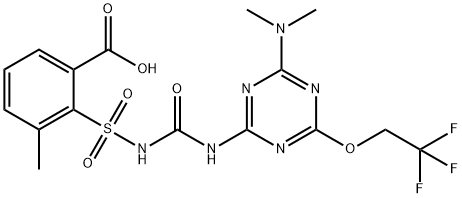
Uses
Triflusulfuron is derived from Triflusulfuron-methyl (T782000), which is widely used sulfonylurea herbicide.
Definition
ChEBI: Triflusulfuron is an N-sulfonylurea that is urea in which a hydrogen attached to one of the nitrogens has been replaced by a (2-carboxy-6-methylphenyl)sulfonyl group, while a hydrogen attached to the other nitrogen has been replaced by a 4-(dimethylamino)-6-(2,2,2-trifluoroethoxy)-1,3,5-triazin-2-yl group. An acetolactate synthase inhibitor, it is used (generally as the corresponding methyl ester proherbicide) to control annual and perennial broad-leaved weeds in sugar beet and other crops. It has a role as an agrochemical, a herbicide and an EC 2.2.1.6 (acetolactate synthase) inhibitor. It is a member of benzoic acids, a N-sulfonylurea, a member of 1,3,5-triazines, a tertiary amino compound, an aromatic ether and an organofluorine compound.
Production Methods
Triflusulfuron is commercially produced via a multi-step synthesis that begins with preparation of the key sulfonyl chloride intermediate, 2-chlorosulfonyl-3-methylbenzoic acid, through a two-step cascade: reaction of 2-nitro-3-methylbenzoic acid with benzyl isothiourea hydrochloride in an aprotic solvent under basic conditions to form a benzyl thioether intermediate, followed by direct oxidation with chlorine gas or sodium hypochlorite in dichloromethane at controlled temperatures, yielding the sulfonyl chloride after extraction, concentration, and crystallisation. This intermediate is then hydrolysed to the corresponding sulfonamide and silylated to form the N-silylsulfonamide. Concurrently, the triazine heterocycle is synthesised from cyanuric chloride via sequential nucleophilic aromatic substitutions: first with 2,2,2-trifluoroethanol under basic conditions, then dimethylamine, and finally ammonia, followed by conversion to the carbamate using phosgene or a phosgene equivalent. The silylated sulfonamide is coupled with the triazine carbamate in an aprotic solvent at ambient temperature to form the sulfonylurea linkage, with the crude product purified by acidification, filtration, and recrystallisation from aqueous solvents to produce the active compound.
Mechanism of action
Selective, inhibits amino acid sysnthesis. Inhibits plant amino acid synthesis - acetohydroxyacid synthase AHAS