Ethylene Glycol Diglycidyl Ether: Epoxy Active Diluent & Crosslinker
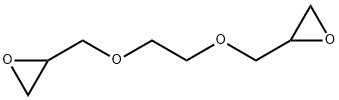
Ethylene Glycol Diglycidyl Ether is an important aliphatic epoxy resin. It is commonly used as an active diluent for epoxy resins to enhance material flow properties. Industrially, it is widely employed in the preparation of low-viscosity compounds, adhesives, and fabric treatment agents. Ethylene glycol diglycidyl ether also serves as a stabiliser for chlorinated paraffin waxes and a resin modifier, enhancing the mechanical strength and weather resistance of products. Caution is advised during handling due to its irritant properties; direct skin contact should be avoided.

Amoxicillin Release from Chitosan/Ethylene Glycol Diglycidyl Ether
Drug delivery systems (DDSs) have been developed to increase the effectiveness of drug delivery to the treatment site and to minimize drug toxicity due to drug overdose. Drug side effects as a result of overdose can be optimally maintained while drug release is controlled to reduce fluctuations in its concentration. These characteristics made it possible to be targeted to specific tissues or cells, allowing for more effective treatment of specific conditions. Over the past few years, numerous researchers have dedicated substantial effort to the comprehensive exploration of biomaterials designed for drug delivery. Ethylene glycol diglycidyl ether (EGDE) has recently attracted a lot of attention as an effective option to CS hydrogelation due to its nontoxicity compared to glutaraldehyde, water solubility, and bifunctional diepoxy groups having the ability of cross-linking with the amino groups (−NH2) of the d-glucosamine units of the CS biopolymer, improving its mechanical and elastic properties due to the covalent bonding of EGDE with CS. Hence, it is important to fully characterize CS/ Ethylene glycol diglycidyl ether hydrogel drugs when adapting US external triggering to drug release. In the present study, US-triggered DDSs based on amoxicillin-loaded CS/EGDE hydrogel are described.[1]
Here, the drug amoxicillin (Amox) is an analog of ampicillin, has a semisynthetic antibiotic effect, and is used to treat bacterial infections for wound-healing treatment because it has essentially the same broad spectrum of bacteriocidal activities against many Gram-positive and certain Gram-negative microorganisms. Thus, the drawbacks of antibiotics, such as overdosage, toxicity, and stability, can be controlled with the use of Amox-entrapped hydrogels. As a potential drug release technique, we aim to investigate the Amox-entrapped hydrogel of the CS/ Ethylene glycol diglycidyl ether matrix and US-stimulated amoxicillin release. For the purpose of studying the CS/EGDE hydrogel properties of US, the effect of US on the Amox-entrapped hydrogel drugs is investigated. In the present study, the release of Amox from the CS/ Ethylene glycol diglycidyl ether/Amox hydrogel matrix in response to US was studied under various US powers (0–35 W) at 43 kHz. When the CS concentrations for gelation were increased, the resultant hydrogel matrices formed a dense CS network, especially in 3 wt %. In the case of the Amox-entrapped CS/ Ethylene glycol diglycidyl ether hydrogel, 2% CS/EGDE could entrap a greater amount of Amox entrapment due to its porous structure, resulting in efficient Amox release under US triggering. As the US power increased from 10 to 35 W at 43 kHz, the release efficiency of the drug also increased.
Ethylene glycol diglycidyl ether crosslinked chitosan electrospun membranes
Composite Crosslinked nanofibrous membranes of chitosan, ethylene glycol diglycidyl ether (EGDE) and polyethylene oxide was successfully prepared with bead free morphology via electrospinning technique followed by heat mediated chemical crosslinking. Architectural stability of nanofiber mat in aqueous medium was achieved by chemical crosslinking of only 1% EGDE, and tensile strength tests revealed that increasing ethylene glycol diglycidyl ether content has considerably enhance the elastic modulus of nanofibers. The structure, morphology and mechanical properties of nanofibers were characterized by Attenuated Total Reflection-Fourier Transform Infrared spectroscopy (ATR-FTIR), scanning electron microscopy (SEM) and Instron machine, respectively. Skin fibroblasts and endothelial cells showed good attachment, proliferation and viability on crosslinked electrospun membranes. The results indicate a good biocompatibility and non-toxic nature of the resulted membrane.[2]
References
[1]Tran Vo TM, Potiyaraj P, Del Val P, Kobayashi T. Ultrasound-Triggered Amoxicillin Release from Chitosan/Ethylene Glycol Diglycidyl Ether/Amoxicillin Hydrogels Having a Covalently Bonded Network. ACS Omega. 2023 Dec 19;9(1):585-597. doi: 10.1021/acsomega.3c06213. PMID: 38222581; PMCID: PMC10785092.
[2]Aqil, A et al. “Preparation and characterizations of EGDE crosslinked chitosan electrospun membranes.” Clinical hemorheology and microcirculation vol. 60,1 (2015): 39-50. doi:10.3233/CH-151930
You may like
See also


Lastest Price from Ethylene glycol diglycidyl ether manufacturers
US $0.00/KG2025-04-15
- CAS:
- 2224-15-9
- Min. Order:
- 1KG
- Purity:
- 99%
- Supply Ability:
- 500000kg
US $80.00/kg2025-04-15
- CAS:
- 2224-15-9
- Min. Order:
- 1kg
- Purity:
- 99
- Supply Ability:
- 5000