Biological Research and Property of Fluorescein 5(6)-isothiocyanate
Fluorescein 5(6)-isothiocyanate, a biochemical reagent appearing as a yellow powder under ambient conditions, exhibits good solubility in aqueous media while undergoing gradual decomposition upon dissolution. As an amine-reactive derivative of fluorescein, Fluorescein 5(6)-isothiocyanate serves as a versatile fluorescent dye with broad applications, being extensively employed for labeling antibodies and other probes in techniques such as fluorescence microscopy, flow cytometry, and immunofluorescence assays including ELISA and Western blot experiments.

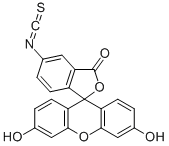
Figure1: Picture of Fluorescein 5(6)-isothiocyanate
General Introduction
Fluorescein 5(6)-isothiocyanate (FITC) was initially developed in 1942 by Coons as a technique for antibody labeling, with its synthetic methodology being subsequently refined and simplified by Metcalf and coworkers in 1958. As one of the most widely employed amine-targeting fluorescent probes, Fluorescein 5(6)-isothiocyanate (FITC) has been utilized in over 22,000 scientific publications for labeling proteins and, more contemporarily, diverse nanomaterials, with conjugation achieved through its isothiocyanate functional group that demonstrates reactivity toward both primary amines and thiols. Despite this dual reactivity, the thiol-specific responsiveness of FITC has remained relatively unexplored, although early investigations by Wilderspin and Green documented that the thiol-FITC interaction proceeds rapidly and can be detected through a slight blue-shift in the absorption spectrum, while concomitant alterations in the fluorescence emission profile were not systematically characterized. luorescein isothiocyanate (FITC) and related hydroxyxanthene dyes are currently experiencing expanded utilization across both established and emerging domains of chemistry and allied sciences, with fluorescein-based compounds seeing specific application in sensor technology, Langmuir-Brodgett monolayers and films, immunoassay microchips, molecular beacons, nanochemistry, and supramolecular systems. Emerging research directions are increasingly focused on exploiting the photophysical and photochemical characteristics of previously underexplored fluorescein derivatives and structural analogs. The distinctive combination of intense fluorescence emission within the peak sensitivity range of human vision, variable fluorescence and autofluorescence signatures observed in microorganisms and tissues, and solubility under weakly alkaline conditions collectively establishes Fluorescein 5(6)-isothiocyanate (FITC) as the predominant choice among conventional protein biomarkers. [1]
Property
Fluorescein 5(6)-isothiocyanate (FITC) has been subjected to comprehensive quantum mechanical investigation to elucidate its conformational preferences, molecular geometry, basicity, and spectroscopic characteristics in both gaseous and aqueous environments, with particular focus on its neutral, monoanionic, and dianionic states. The computational results demonstrate that the neutral Fluorescein 5(6)-isothiocyanate (FITC) exhibits multiple conformational states of comparable stability between gas phase and solution, each contributing significantly to its structural ensemble, while excitation energy calculations further indicate pronounced sensitivity of spectroscopic properties to solvation relaxation effects. Excellent agreement with experimental data was achieved through time-dependent density functional theory for the neutral species, although the theoretical methods showed limited accuracy in reproducing the spectral trends observed for the charged derivatives. Fluorescein 5(6)-isothiocyanate is a medical diagnostic agent primarily employed as a fluorescent dye in antibody labeling techniques, capable of binding to various antibody proteins without compromising their specific immunoreactivity toward target antigens while exhibiting intense green fluorescence in alkaline solutions. As a versatile diagnostic tool, Fluorescein 5(6)-isothiocyanate enables rapid detection of diseases caused by bacteria, viruses, and parasites across medical, agricultural, and livestock applications. [2]
Biological Research
Fluorescein 5(6)-isothiocyanate-conjugated goat anti-human antibody (GAHAb-FITC) and rabbit anti-goat antibody (RAGAb-FITC), along with their immunocomplexes formed through three distinct immunization protocols with human immunoglobulin (IgG), were systematically investigated to determine the optimal conditions for room-temperature phosphorescence (RTP) emission on various solid thin-film substrates, as well as their corresponding spectral characteristics, intensity, and lifetime. The study revealed that both the labeled antibodies and their immunocomplexes retained the excellent solid-substrate RTP properties inherent to Fluorescein 5(6)-isothiocyanate, with maximum excitation/emission wavelengths of 525/650 nm, demonstrating linearly concentration-dependent RTP intensity and high detection sensitivity. Notably, the immunological reaction and subsequent RTP detection could be sequentially performed on the same substrate, significantly streamlining the analytical procedure. When using polyamide membrane as the substrate and lead acetate as the heavy-atom perturber, both GAHAb-FITC and RAGAb-FITC at a 1:10 dilution ratio, as well as their respective immunocomplexes with human IgG, exhibited strong RTP signals and prolonged phosphorescence lifetimes. These findings establish a substantial experimental foundation for developing a novel solid-substrate room-temperature phosphorescence immunoassay methodology. [3]
Reference
[1] Mark N. Potter, Fluorescein 5(6)-isothiocyanate, a platform for the selective and sensitive detection of S-Nitrosothiols and hydrogen sulfide, Talanta, 2022, 237, 15.
[2] Jordi Casanovas, Fluorescein 5(6)-isothiocyanate: Molecular characterization by theoretical calculations, Chemical Physics 354 2008, 354, 155–161.
[3] Liu J M, Fu Y, Yu B B, et al. Study on solid substrate room-temperature phosphorescence properties of Fluorescein 5(6)-isothiocyanate labeled antibodies[J]. Spectroscopy and Spectral Analysis, 2002,22(3): 425-428.
You may like
See also


Lastest Price from Fluorescein isothiocyanate manufacturers
US $0.00-0.00/KG2025-04-21
- CAS:
- 27072-45-3
- Min. Order:
- 1KG
- Purity:
- 99%
- Supply Ability:
- 20 mt
US $100.00/bag2023-09-07
- CAS:
- 27072-45-3
- Min. Order:
- 1bag
- Purity:
- 99
- Supply Ability:
- 5000