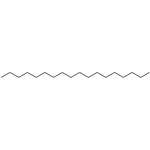
Octadecane is an alkane hydrocarbon that has the molecular formula CH3(CH2)16CH3. It is a straight-chain alkane that carries 18 carbon atoms. Octadecane has a role as a plant metabolite and a bacterial metabolite. It is found in alcoholic beverages, hop oil, aband other plant resources. Octadecane is a colorless liquid that has a fuel-like smell. It is soluble in water, slightly soluble in ethanol and soluble. It is also soluble in acetone, ethyl ether, chloroform, petroleum, ether, and coal tar hydrocarbons.
n-octadecane is used as a solvent, a lubricant, transformer oil and an anti-corrosion agent. It is also used in paraffin and as a chemical intermediate in organic synthesis. It plays an important role in pheromones as a chemical messenger. N-Octadecane/ molecular sieve 5A composites find application as thermal storage material.
ChEBI: A straight-chain alkane carrying 18 carbon atoms.
Saturated aliphatic hydrocarbons, such as Octadecane, may be incompatible with strong oxidizing agents like nitric acid. Charring of the hydrocarbon may occur followed by ignition of unreacted hydrocarbon and other nearby combustibles. In other settings, aliphatic saturated hydrocarbons are mostly unreactive. They are not affected by aqueous solutions of acids, alkalis, most oxidizing agents, and most reducing agents. When heated sufficiently or when ignited in the presence of air, oxygen or strong oxidizing agents, they burn exothermically to produce carbon dioxide and water.
Crystallise it from acetone and distil it from sodium in a vacuum. [Beilstein 1 IV 553.]
Properties and Applications
Octadecane (n-Octadecane) is part of the paraffin family; its chemical formula is C18H38, and it is a solid at room temperature. Its melting point lies between 28 and 30 °C, its heat capacity is 2.22 J/K·g, and its viscosity is 4.21 mPa·s (20 °C). During the phase transition, the thermal conductivity changes from 0.198 W/m·K (solid) to
0.222 W/m·K (liquid). Octadecane can be used as a phase-change material (PCM) to prepare novel phase-change composites suitable for building cooling applications. Recycled aluminium was added to these composites at concentrations of 7% and 7.5% (by volume) as a thermal conductivity enhancer to prevent sinking during the molten phase and to improve thermal conductivity. Furthermore, research has shown that, compared to octadecane, the addition of aluminium shavings can increase the thermal conductivity of the composite by 100% (octadecane-short aluminium) and 600% (octadecane-long aluminium), whereas the mass increase remains relatively low[1].
[1] Nicoleta Cobîrzan. (2025). Properties of n-Octadecane PCM Composite with Recycled Aluminum as a Thermal Enhancer. Materials, 18 24. https://doi.org/
10.3390/ma18245638