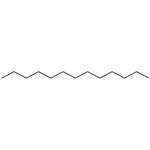
n-Tridecane is used as a distillation chaser. It is a component of various fuels and solvents used in industry.
Organic synthesis, distillation chaser.
ChEBI: Tridecane is a straight chain alkane containing 13 carbon atoms. It forms a component of the essential oils isolated from plants such as Abelmoschus esculentus. It has a role as a plant metabolite and a volatile oil component.
Tridecane serves not only as an industrial fuel or organic solvent, but also as an emollient in skincare and cosmetic products. It helps to keep the skin moisturised, soothe the skin and improve its texture, whilst not clogging the pores, making it suitable for those with oily, combination and sensitive skin.
An oily straw yellow clear liquid with a hydrocarbon odor. Flash point 190-196°F. Specific gravity 0.76. Boiling point 456°F. Repeated or prolonged skin contact may irritate or redden skin, progressing to dermatitis. Exposure to high concentrations of vapor may result in headache and stupor.
Saturated aliphatic hydrocarbons, such as n-Tridecane, may be incompatible with strong oxidizing agents like nitric acid. Charring of the hydrocarbon may occur followed by ignition of unreacted hydrocarbon and other nearby combustibles. In other settings, aliphatic saturated hydrocarbons are mostly unreactive. They are not affected by aqueous solutions of acids, alkalis, most oxidizing agents, and most reducing agents. When heated sufficiently or when ignited in the presence of air, oxygen or strong oxidizing agents, they burn exothermically to produce carbon dioxide and water.
May be harmful by inhalation, ingestion or skin absorption. Vapor or mist is irritating to the eyes, mucous membrane and upper respiratory tract. Causes skin irritation.
Moderately toxic by intravenousroute. When heated to decomposition it emits acrid smokeand irritating fumes.
Tridecane (n-Tridecane) was synthesised by reacting C13-condensed (1,5-bis(2-furanyl)-1,4-pentadien-3-one) as the starting material, with acetone as the solvent and Pt/Al₂O₃ as the catalyst, for 24 hours at 493 K and 5.5 MPa. The yield exceeded 22%. The general mechanism of its synthesis is as follows:
it is a sequence of four steps with different catalysts at different reaction conditions: the hydrolysis of the sugar polymers; followed by the dehydration of sugars yielding aldehydes; the con densation of these compounds using a linking molecule (usually acetone); and the total hydrodeoxygenation of these condensation adducts to the final lineal hydrocarbons, with similar properties as the mineral diesel
[1].

n-Tridecane is obtained by petrochemical refining.
Mice treated with tridecane
developed tumors on their backs, after exposure to ultraviolet
radiation at wavelengths longer than 350 nm, generally
considered noncarcinogenic.
[1] Laura Faba. (2016). Hydrodeoxygenation of furfural-acetone condensation adducts to tridecane over platinum catalysts. Catalysis Today, 269, Pages 132-139. https://doi.org/
10.1016/j.cattod.2015.09.055