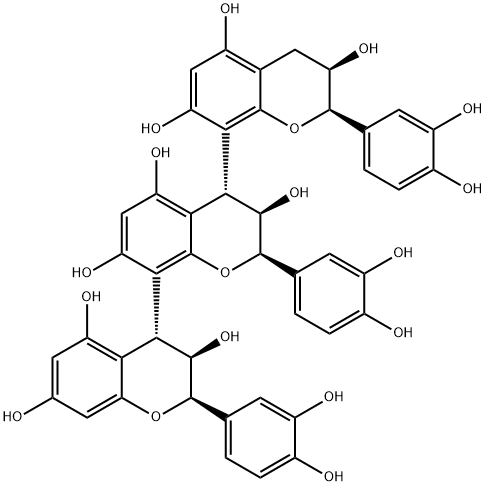
Procyanidin C1 is a polyphenol flavonoid trimer of (–)-epicatechin that has HIV-related and antioxidant activities. It activates latent HIV-1 provirus in JLR2 cells when used at concentrations ranging from 12.5 to 50 μM and increases NF-κB-dependent transcriptional activity in Jurkat T cells. Procyanidin C1 also scavenges 2,2’-diphenyl-1-picrylhydrazyl (DPPH) radicals (IC50 = 3.2 μg/ml) and inhibits the activity of α-glucosidase (IC50 = 3.8 μg/ml) and 15-lipoxygenase (15-LO; IC50 = 57.6 μg/ml). Procyanidin C1 (10 μg/ml) prevents phosphorylation of ERK1/2 and the production of reactive oxygen species (ROS) in THP-1 cells.
Procyanidin C1 (PCC1), a natural polyphenol with oral activity, causes DNA damage, cell cycle arrest and induces apoptosis. Procyanidin C1 decreases the level of Bcl-2, but enhances BAX, caspase 3 and 9 expression in cancer cells. Procyanidin C1 shows senotherapeutic activity and increases lifespan in mice[1][2].
ChEBI: Procyanidin C1 is a proanthocyanidin consisting of three (-)-epicatechin units joined by two successive (4beta->8)-linkages. It has a role as a metabolite, an anti-inflammatory agent, an antioxidant, a lipoxygenase inhibitor, an EC 1.17.3.2 (xanthine oxidase) inhibitor and an EC 3.2.1.20 (alpha-glucosidase) inhibitor. It is a hydroxyflavan, a proanthocyanidin and a polyphenol. It is functionally related to a (-)-epicatechin.
Procyanidin C1 (20 mg/kg; i.p.; 2 weeks after the first MIT dose and then delivered biweekly) increases tumour regression[2]. Procyanidin C1 (20 mg/kg; i.p.; for 7 d) shows senolytic efficacy in mice with senescent mouse embryonic fibroblasts injection[2]. Procyanidin C1 (20 mg/kg; p.o.; for 3 d) increases the lifespan of old mice[2].
| Animal Model: | Non-obese diabetes and severe combined immunodficiency mice with PSC27 and PC3 cancer cells injection, and pre-treated with mitoxantrone (MIT)[2] |
| Dosage: | 20 mg/kg |
| Administration: | Intraperitoneal injection; 20 mg/kg; 2 weeks after the first MIT dose and then delivered biweekly |
| Result: | Remarkably enhanced tumour regression (55.2% reduction in tumour size compared with
MIT alone; 74.9% reduction in tumour volume compared with the placebo treatment) and depleted the majority of senescent cells in chemotherapy treated animals.
|
| Animal Model: | 24-27 months of age mice (both sexes)[2] |
| Dosage: | 20 mg/kg |
| Administration: | Oral gavage; 20 mg/kg; for three consecutive days |
| Result: | Enhanced the median post-treatment lifespan with 64.2% and decreased the mortality hazard than the vehicle-treated group.
|
[1] Koteswari LL, et al. A comparative anticancer study on procyanidin C1 against receptor positive and receptor negative breast cancer. Nat Prod Res. 2019 Jan 8:1-8. DOI:
10.1080/14786419.2018.1557173[2] Xu Q, et al. The flavonoid procyanidin C1 has senotherapeutic activity and increases lifespan in mice. Nat Metab. 2021 Dec;3(12):1706-1726. DOI:
10.1038/s42255-021-00491-8