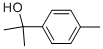
Reported found in cranberry and bilberry, currants, mint, pepper, apricot, orange juice, lemon peel oil, grapefruit
juice, mandarin peel oil, tangerine peel oil, satsuma mandarin peel oil, pineapple, fresh blackberry, heated blackberry, ginger,
Scotch spearmint oil, parsley leaves, Thymus vulgaris L., Thymus zygis L., carrot, tomato, nutmeg, mace, parsley, Gruyere cheese,
cognac, tea, passion fruit, plum, rose, apple, sweet marjoram, mango, parsnip, licorice, dill, juniper berry, myrtle leaf, rosemary,
buchu oil, lemon balm, clary sage, Spanish sage, okra, cape gooseberry, pimento berry, calabash nutmeg, ashanti pepper, sweet grass
oil, angelica root oil, eucalyptus oil and mastic gum oil.
2-(4-Methylphenyl)propan-2-ol is an alcohol. Flammable and/or toxic gases are generated by the combination of alcohols with alkali metals, nitrides, and strong reducing agents. They react with oxoacids and carboxylic acids to form esters plus water. Oxidizing agents convert them to aldehydes or ketones. Alcohols exhibit both weak acid and weak base behavior. They may initiate the polymerization of isocyanates and epoxides. 2-(4-Methylphenyl)propan-2-ol is incompatible with strong oxidizing agents.
2-(4-Methylphenyl)propan-2-ol can be obtained by oxidizing 4-methylisopropylbenzene.
In a 25 mL reaction tube, 0.0011 g (0.001 mmol) of manganese(II) 5,10,15,20-tetrakis(2,3,6-trichlorophenyl)porphyrin was dispersed in 1.3422 g (10 mmol) of 4-methylisopropylbenzene, stirred to raise the temperature to 80 C, and oxygen (1.0 atm) was passed through the tube. The reaction was stirred at 800 rpm at 80 C for 8.0 h. After the reaction was completed and cooled to room temperature, 1.3115 g (5.00 mmol) of triphenylphosphine (PPh3) was added to the reaction mixture and stirred at room temperature for 40 min to reduce the generated peroxide. Using acetone as solvent, the resulting reaction mixture was volume-determined to 50 mL. 10 mL of the resulting solution was pipetted and analyzed by gas chromatography using naphthalene as internal standard. 4-Methylisopropylbenzene was converted by 20.8%, 2-(4-methylphenyl)propan-2-ol was selective by 51%, 4-methylacetophenone was selective by 0%, 4-methylisopropylbenzene hydroperoxides were selective by 49%, and the formation of benzoic acid was not detected.